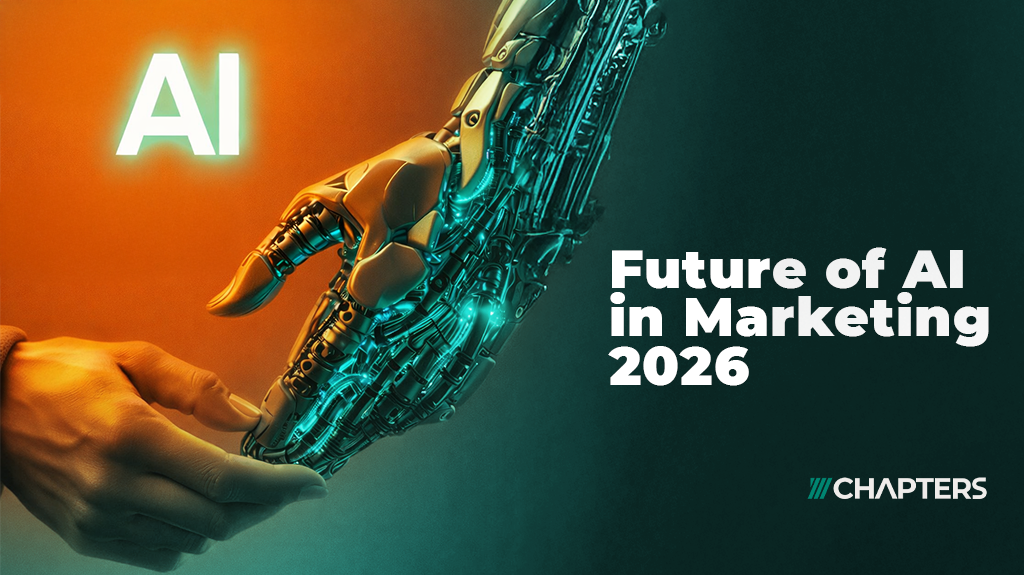

Every year since 2022, marketing teams have been told that AI is about to change everything. In 2026, it already has, and the more important question is no longer whether AI will reshape marketing, but which specific shifts are happening now, which are still ahead, and how brands that want to lead should be positioning themselves for what comes next.
This is not a list of tools. It is not a beginner’s guide to prompting. This is a strategic assessment of AI marketing predictions for 2026 and beyond, grounded in data, informed by live client work at Chapters Digital Solutions, and written for the decision-makers who need to understand where AI is taking the industry, not just what it can do today.
If you want a broader view of how AI is being applied across channels and disciplines, our all AI topics hub covers the full landscape, from AI keyword research and content strategy to AI agents, automation, and predictive targeting. This article focuses specifically on the strategic horizon: where the industry is going and what the most important ai marketing predictions tell us about the decisions brands need to make right now.
Where We Are: The 2026 AI Marketing Baseline
Before looking forward, it is worth being precise about where we actually are. The AI marketing predictions that dominated conversations in 2023 and 2024, AI will automate content creation, AI will replace media buyers, and AI will personalize at scale, have landed, but not uniformly.
Here is what has actually happened:
| AI Marketing Prediction (2023–24) | Reality in 2026 | Maturity Level |
| AI will automate content creation | Partially true, AI accelerates production but human strategy and editorial judgment remain essential for quality | Mainstream |
| AI will replace media buyers | False at the role level, true at the task level, AI handles bid management, audiences, and reporting; humans handle strategy | Mainstream |
| AI will personalize at scale | True for leaders, delayed for most, personalization at scale requires a first-party data infrastructure that most brands lack | Early Majority |
| AI will transform SEO | True, AI Overviews, semantic search, and AI-driven content evaluation have fundamentally changed SEO requirements | Mainstream |
| AI agents will run marketing workflows | Emerging, early adopters are deploying AI agents for reporting, briefing, and campaign QA; widespread adoption is 12–18 months away | Early Adopter |
| Generative AI will dominate ad creatives | Partially, AI creative tools are widely used for iteration and testing; brand-defining creative still requires human direction | Early Majority |
The pattern is consistent: AI has delivered most on the execution-and-automation layer of marketing, including bidding, reporting, content production, and audience segmentation. It has delivered least on the strategy and judgment layer, brand positioning, creative direction, audience insight, and long-term planning. This distinction matters enormously for the predictions that follow.
7 AI Marketing Predictions That Will Define the Next 18 Months
Prediction 1: The Strategy Gap Becomes the Primary Competitive Differentiator
As AI tools democratize execution, making it easier and cheaper to produce content, run campaigns, and generate reports, the brands and agencies that win will be those with superior strategic judgment. When everyone has access to the same AI tools, the differentiator is the quality of the thinking that directs them.
According to McKinsey’s 2025 State of AI report, companies in the top quartile of AI adoption are not distinguished by their tool stack, they are distinguished by how clearly they have defined what AI should and should not decide. The clearest AI marketing prediction for the next 18 months: strategy becomes the moat. Brands that invest in strategic clarity alongside AI capability will compound; brands that invest in tools alone will plateau.
Prediction 2: First-Party Data Infrastructure Determines AI Performance Ceiling
Every major AI marketing capability, from Smart Bidding and Performance Max to AI personalization and predictive targeting, runs on data. In 2026, with third-party cookies fully deprecated and privacy regulations tightening globally, the quality of a brand’s first-party data infrastructure is now the single most important determinant of AI marketing performance.
Brands with rich, well-structured CRM data, robust GA4 event tracking, and Enhanced Conversions implementation are seeing AI tools perform dramatically better than competitors running the same campaigns without that foundation. The prediction: the first-party data gap will widen significantly over the next 18 months, creating a performance ceiling for brands that have not invested in data infrastructure.
Chapters Observation
Across paid media accounts we manage, clients with properly implemented first-party data signals (Enhanced Conversions + Customer Match + GA4 integration) are seeing 23–31% lower CPAs than comparable accounts without this infrastructure, running identical campaign types and bid strategies.
Prediction 3: AI Agents Move from Experiment to Standard Operating Procedure
AI agents, autonomous systems that can execute multi-step marketing tasks without human intervention at each step, are the most consequential near-term development in AI marketing. In 2025, they were an early-adopter experiment. By the end of 2026, they will be standard operating procedure for the most efficient marketing teams.
The use cases that are maturing fastest include: automated campaign performance reporting with anomaly flagging, AI-driven content briefing and first-draft generation, competitive monitoring and SERP change detection, and budget pacing alerts with recommended reallocation. The teams building these workflows now are compressing what used to take 4–6 hours of analyst time into automated outputs that arrive before the team starts work.
Prediction 4: Search Visibility Fractures Into Three Distinct Channels
One of the most important ai marketing predictions for SEO and content teams: search visibility in 2026 and beyond is not a single channel, it is three distinct surfaces, each with different optimization requirements:
- Traditional organic rankings: Still relevant, especially for navigational and branded queries, but increasingly subordinate to AI-generated results for informational intent.
- AI Overview citations: The new premium surface for informational and research queries. Winning here requires structured content, EEAT signals, schema markup, and direct answer formatting.
- AI assistant and chatbot responses: ChatGPT, Gemini, Perplexity, and similar tools are now meaningful traffic sources. Being cited in AI assistant responses requires the same signals as AI Overviews, but with stronger emphasis on topical authority and source credibility.
Brands that optimize for all three surfaces will have a compounding visibility advantage. Brands that optimize only for traditional rankings are already losing ground in the first two, and the gap will widen.
Prediction 5: Creative Strategy Becomes AI Marketing’s Last Human Frontier
Counterintuitively, one of the clearest AI marketing predictions is that human creativity becomes more valuable, not less, as AI handles more of marketing’s execution layer. As AI tools make it easier to produce competent, on-brand content at scale, the creative ideas that break through, the campaign concepts, the brand narratives, the cultural connections, become increasingly rare and increasingly valuable.
The brands winning with AI-powered creative in 2026 are not the ones generating the most content, they are the ones generating the most distinctively human ideas, then using AI to execute, iterate, and scale those ideas with unprecedented efficiency. The prediction: creative strategy becomes the highest-value human skill in marketing over the next 18 months.
Prediction 6: AI-Driven Personalization Moves Beyond Segments to Individuals
True one-to-one personalization, long promised and long delayed, is becoming technically achievable for brands with the right data infrastructure in 2026. AI systems can now synthesize behavioral signals, purchase history, session context, and predictive intent models to deliver genuinely individualized experiences at scale.
The constraint is no longer the technology. It is the data quality and organizational readiness to deploy it. Brands that have invested in unified customer data platforms (CDPs), clean first-party data, and cross-channel identity resolution are beginning to see personalization capabilities that were theoretically possible in 2022 but practically unavailable. By 2027, this will be a mainstream expectation. Brands starting now have an 18-month window to build a compounding advantage.
Prediction 7: AI Marketing ROI Measurement Becomes a Discipline of Its Own
As AI is embedded across more marketing functions, content, paid, SEO, personalization, reporting, measuring its specific contribution to revenue becomes both more important and more complex. The final major ai marketing prediction for the next 18 months: AI ROI measurement emerges as a distinct organizational capability, with dedicated frameworks, tools, and roles.
The brands that will lead are those that can answer clearly: which AI investments are generating measurable revenue impact, and which are generating activity without outcomes? This requires incrementality testing, attribution modeling that accounts for AI-assisted touchpoints, and executive-level literacy about what AI can and cannot be credited for.
AI Marketing in the Context of Broader Digital Trends 2026
The AI marketing predictions above do not exist in isolation. They are accelerated and shaped by the broader digital trends 2026 that are simultaneously reshaping consumer behavior, platform dynamics, and business models. Three macro trends are particularly consequential for how AI marketing evolves:
The attention economy is fracturing
With users distributing attention across more surfaces, short-form video, AI assistants, messaging platforms, and audio, the traditional funnel model of digital marketing is losing predictive reliability. AI marketing’s response is to follow attention dynamically, deploying content and ads where signals suggest individual users are most receptive, rather than where historical averages suggest audiences congregate.
Trust is becoming the scarcest resource in digital marketing
As AI-generated content floods every channel, users are becoming more skeptical of content provenance and more reliant on signals of genuine expertise. This is why EEAT standards are tightening, why creator-led marketing is growing, and why brands with authentic human voices and verifiable expertise are outperforming those optimizing purely for algorithmic visibility.
The line between marketing and product is dissolving
AI-powered personalization, recommendation engines, and conversational interfaces mean that the marketing experience and the product experience are increasingly the same thing. The most advanced AI marketing deployments in 2026 are not campaigns; they are intelligent product surfaces that market as they function.
What AI Marketing Predictions Mean for Your Business Today
The strategic implications of these predictions are concrete and time-sensitive:
- Audit your first-party data infrastructure now. Every AI marketing capability has a data ceiling. Know where yours is and what it would take to raise it.
- Define what AI decides and what humans decide. The most effective AI marketing operations are not the most automated; they are the most intentional about where human judgment is irreplaceable.
- Start building AI agent workflows for your highest-repetition tasks. Reporting, briefing, and performance monitoring are the highest-ROI starting points for most marketing teams.
- Optimize for all three search surfaces. Traditional rankings, AI Overviews, and AI assistant citations require different content structures. Build for all three simultaneously.
- Invest in creative strategy, not just creative production. As AI handles more execution, the ideas that direct it become more valuable. Protect and develop your strategic creative capacity.
- Build an AI ROI measurement framework. You cannot manage what you cannot measure. Define how AI contributions will be evaluated before the tools proliferate further.
Chapters Strategic Principle
At Chapters Digital Solutions, we evaluate every AI marketing investment against one question: Does this make our strategic thinking faster and sharper, or does it just make our output faster? The first type of compounds. The second type commoditizes. The difference determines whether AI becomes a competitive advantage or a race to the bottom.
A Closing Thought: The Most Important AI Marketing Prediction Is About People
Every significant AI marketing prediction for 2026 and beyond points to the same underlying truth: AI is extraordinarily powerful at executing defined tasks efficiently. It is not capable of caring about outcomes, understanding human context, or making genuinely creative leaps. Those capabilities remain entirely human.
The brands that will lead in AI-powered marketing are not the ones that automate the most. They are the ones that are most clear about what they are trying to achieve and why it matters, and that use AI to pursue that clarity with unprecedented speed and scale. Strategy, creativity, and genuine customer understanding are not things AI is coming for. They are what make AI worth having.
The future of AI in marketing belongs to the marketers who understand this distinction deeply enough to act on it, who invest in both the human capabilities and the technical infrastructure that make AI work at its best. The prediction is not that AI replaces marketing. The prediction is that AI reveals, more clearly than ever, which marketers were adding genuine value all along.
At Chapters Digital Solutions, that is the standard we hold ourselves to, and the one we help our clients build toward. The future is not automated. It is augmented. And the augmentation compounds in direct proportion to the quality of the human judgment directing it.
Ready to Build an AI Marketing Strategy That Compounds?
Chapters Digital Solutions helps brands develop AI marketing strategies grounded in data, structured for performance, and built for the long term. Visit chapters-eg.com to learn more about our AI strategy and implementation services.