

Artificial intelligence is no longer a future concept in search; it’s already reshaping how SEO teams research, optimize, publish, and scale. One of the most powerful shifts we’re seeing in 2026 and beyond is the rise of AI agents for SEO.
At Chapters Digital Solutions, we view AI Agents SEO not as tools, but as operational systems that automate repetitive SEO workflows, surface insights faster, and allow strategists to focus on high-impact decisions. In this article, we break down how AI agents work, where they fit within modern SEO automation, and how businesses can deploy them responsibly to gain a competitive edge.
What Are AI Agents in SEO?
AI agents are autonomous or semi-autonomous systems designed to perform specific tasks based on rules, data inputs, and learning models. In an SEO context, AI agents for SEO can:
- Analyze SERPs at scale
- Cluster keywords semantically
- Monitor rankings and competitors
- Generate optimization recommendations
- Trigger actions across tools and platforms
Unlike traditional automation scripts, AI agents can adapt, prioritize, and sequence tasks, making them especially powerful for large or complex SEO ecosystems.
Why AI Agents Matter for Modern SEO
SEO in 2026 is no longer about optimizing individual pages in isolation. It’s about managing systems:
- Thousands of URLs
- Constant SERP volatility
- AI-generated search results
- Multi-channel attribution
Manual workflows simply don’t scale. AI agents solve this by acting as always-on SEO operators that reduce lag between insight and execution.
From our experience managing enterprise and mid-market accounts, the biggest performance gains come when AI agents are embedded into daily SEO operations, not used as one-off experiments.
Core Use Cases for AI Agents in SEO Automation
1. Keyword Research & Semantic Clustering
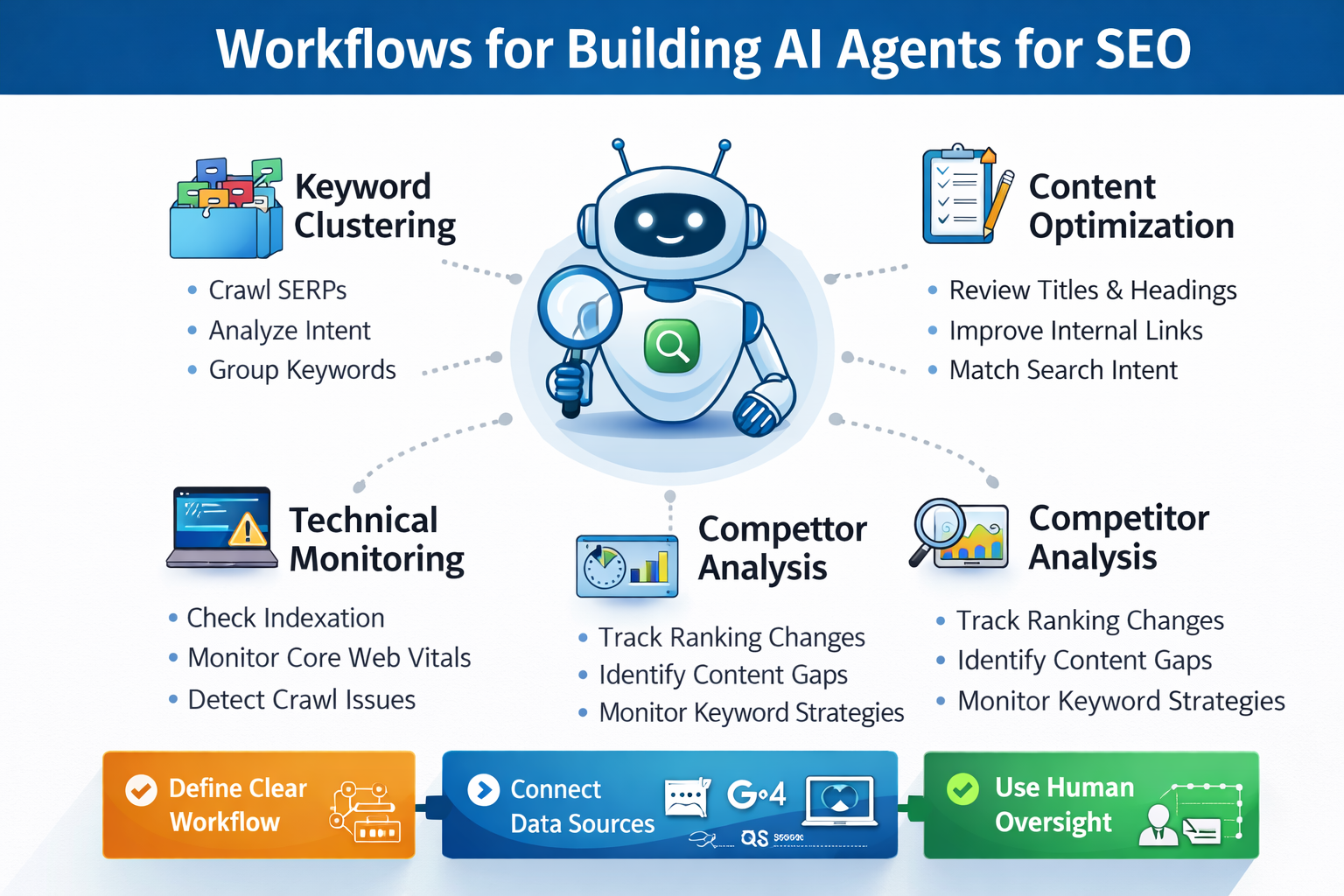
AI agents can crawl SERPs, analyze intent patterns, and group keywords into semantic clusters automatically.
Instead of static keyword lists, agents continuously update clusters based on:
- SERP feature changes
- New competing pages
- Search intent shifts
This is critical for building topical authority, especially in AI-driven search environments.
2. Content Gap & Opportunity Detection
An AI SEO agent can compare your site against competitors daily and flag:
- Missing subtopics
- Under-optimized pages
- New ranking opportunities
This transforms competitor analysis from a quarterly task into a real-time signal.
We often configure agents to push these insights directly into content backlogs or task management tools, closing the gap between insight and action.
3. On-Page Optimization at Scale
AI agents SEO can scan pages and recommend improvements for:
- Title tags and meta descriptions
- Header hierarchy
- Internal linking opportunities
- Content depth vs. top-ranking competitors
When combined with editorial oversight, this allows teams to optimize hundreds of pages consistently without sacrificing quality.
4. Technical SEO Monitoring
Technical SEO is one of the most under-automated areas, and one of the most critical.
AI agents SEO can monitor:
- Indexation issues
- Sudden traffic drops
- Crawl anomalies
- Core Web Vitals changes
More importantly, they can prioritize issues based on impact, not just volume, something traditional tools struggle with.
AI Agents and AI Overviews: A New Search Reality
With the expansion of ai overviews in search results, SEO is no longer just about blue links.
AI agents help teams adapt by:
- Tracking how AI-generated answers reference brands
- Identifying content formats favored by AI summaries
- Mapping visibility beyond traditional rankings
This is essential for brands that want to remain discoverable as search interfaces evolve.
Building AI Agents for SEO: The Right Way
Step 1: Define the Workflow, Not the Tool
Before choosing any AI platform, define:
- What decision is being automated?
- What input data is required?
- What action should be triggered?
AI agents are most effective when built around clear workflows, not vague goals.
Step 2: Connect the Right Data Sources
High-performing SEO agents typically integrate with:
- Google Search Console
- GA4
- Crawling tools
- SERP tracking platforms
- Content management systems
The quality of outputs depends entirely on data integrity.
Step 3: Use Human-in-the-Loop Oversight
AI agents should assist, not replace, SEO strategists.
At Chapters, every AI-driven recommendation is reviewed through:
- Search intent validation
- Brand voice alignment
- Commercial impact assessment
This balance is what keeps automation effective and safe.
Competitor Analysis Powered by AI Agents
Traditional competitor analysis is static and quickly outdated.
AI agents change this by:
- Monitoring competitor rankings daily
- Tracking content updates and expansions
- Detecting new keyword targeting strategies
This allows SEO teams to respond proactively, not reactively.
In highly competitive industries, this real-time intelligence is often the difference between maintaining visibility and losing market share.
Scaling SEO Operations with AI + Automation
When AI agents are combined with structured automation platforms, SEO teams unlock true scalability.
For example:
- A ranking drop triggers a content audit
- A new keyword opportunity triggers a content brief
- A competitor update triggers an optimization alert
These Add workflows turn SEO into a responsive system rather than a manual checklist.
Common Mistakes to Avoid
- Treating AI agents as “set and forget” tools
- Automating content without editorial review
- Ignoring search intent and business context
- Chasing efficiency at the expense of quality
AI agents amplify strategy, good or bad. Without a solid SEO foundation, automation simply accelerates mistakes.
The Future of AI Agents in SEO
As search engines become more AI-driven, SEO teams must evolve from page optimizers to system designers.
AI agents will increasingly:
- Coordinate multi-channel search visibility
- Optimize for AI-generated answers
- Support predictive SEO modeling
The teams that win will be those who operationalize expertise, not those who rely solely on tools.
AI Agents Are a Competitive Advantage, If Used Strategically
Building AI agents for SEO isn’t about replacing strategists. It’s about freeing them. When designed correctly, AI agents SEO workflows reduce friction, increase speed, and unlock insights that manual processes can’t reach.
At Chapters Digital Solutions, we build AI-powered SEO systems that combine automation, data intelligence, and human expertise, so growth scales without losing control. If your SEO workflow doesn’t scale, your results won’t either.