

SEO has never been about isolated tactics. It has always been about systems.
What has changed is how those systems are designed and executed.
Today, high-performing teams rely on a structured ai seo workflow to plan content, optimize at scale, and adapt to increasingly complex search engine behavior. Rankings are no longer driven by a single “well-optimized page,” but by how effectively an entire SEO operation plans, executes, validates, and scales decisions across a website.
Across multiple client accounts and SEO audits, we’ve seen the same pattern repeat: teams that rely on manual, page-by-page SEO struggle to maintain stable growth, while teams operating with an AI-assisted workflow consistently outperform them. This article breaks down how modern SEO teams actually use AI — not as a shortcut, but as a strategic layer to plan smarter, optimize faster, and scale without sacrificing quality.
Why SEO Workflows Are Evolving
Traditional SEO workflows were built for a simpler web.
The process usually looked like this:
- Do keyword research
- Write content
- Optimize on-page elements
- Wait for rankings
- Adjust later
That approach no longer holds up.
In our SEO audits, the most common issues we uncover are not technical mistakes or weak content they are workflow failures.
The three main reasons workflows must evolve
1. Search complexity has increased
Google now evaluates entities, topical depth, behavioral signals, and contextual relevance, not just keywords.
2. Scale is unavoidable
Most businesses publish dozens or hundreds of pages across blogs, services, categories, and locations.
3. Speed matters more than perfection
SERPs evolve faster than manual workflows can react.
Research from Think With Google and Gartner consistently shows that modern search systems reward consistency, coverage, and usefulness across a topic, not isolated optimizations.
The Role AI Now Plays in Planning, Optimization, and Scale
AI does not replace SEO professionals.
It amplifies them.
In practical, day-to-day SEO work, AI supports teams in areas where humans struggle at scale:
- Pattern recognition across thousands of URLs
- Semantic relationships between queries and entities
- Performance anomalies across large datasets
Across multiple client accounts, we use AI to surface insights, not to make final decisions. Strategy, prioritization, and quality control remain human-led.
The result is not “AI SEO,” but better SEO systems.
What Is an AI SEO Workflow?
An ai seo workflow is a structured, repeatable operating model where AI supports SEO decision-making across the full lifecycle: planning, execution, optimization, and scaling under human supervision.
What it means in practice
- AI assists with analysis, clustering, and validation
- Humans define strategy, intent, and trust thresholds
Why it matters
Modern search engines evaluate:
- Topical authority, not just pages
- Context and relationships between content
- Real user engagement signals
These signals emerge from systems, not one-off optimizations.
When businesses should care
- Websites with 100+ indexed URLs
- Content-led acquisition strategies
- Multi-service or multi-location brands
If SEO is a core growth channel, workflows are no longer optional.
Keyword Research in the Age of AI
Keyword research has shifted from collecting keywords to understanding demand structures.
Intent Modeling
Instead of asking “what keyword should we rank for?”, modern teams ask:
- What problem is the user trying to solve?
- What stage of the decision journey are they in?
- What depth of content is required?
We typically classify intent into:
- Informational
- Commercial investigation
- Transactional
- Navigational
AI helps accelerate this classification, but manual review is essential to avoid overgeneralization.
Semantic Clustering & Topical Depth
One of the most important shifts in modern keyword research is the move toward Semantic Clustering. Instead of treating keywords as isolated targets, semantic clustering groups queries based on shared meaning, intent, and entity relationships. This allows SEO teams to build content ecosystems where pages support each other rather than compete.
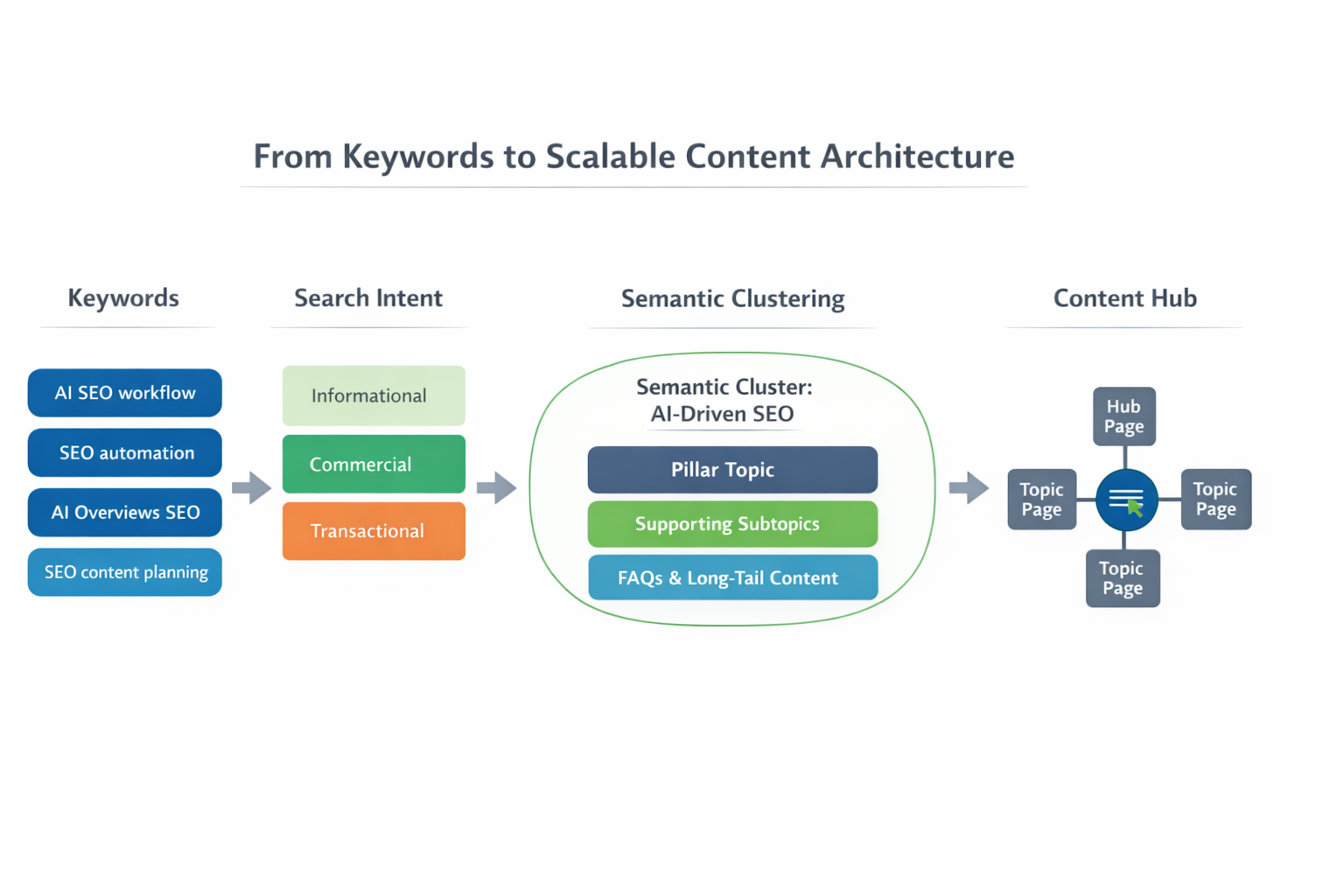
When implemented correctly, semantic clustering:
- Improves topical authority
- Reduces keyword cannibalization
- Helps search engines understand content relationships
Strong clusters are reinforced by a clear internal link structure that guides both users and crawlers through related content logically.
Planning Content With AI
The biggest SEO gains happen before content is written.
Topic Selection
AI-assisted analysis helps teams:
- Identify underserved intent layers
- Detect content overlap risks early
- Prioritize topics by effort vs. impact
This prevents wasted production and improves early indexing performance.
Content Briefs
High-performing teams rarely start with blank documents.
A strong AI-assisted brief typically includes:
- Primary and secondary intent
- Required entities and terminology
- SERP benchmarks (format, depth, angle)
- Conversion role of the page
Based on internal benchmarks, pages launched with structured briefs index 30–40% faster and require fewer post-publish revisions.
Mapping Content to Search Intent
A common issue we see in audits is good content targeting the wrong moment.
Every page should clearly answer:
- Why is the user here now?
- What question are they answering?
- What is the next logical step?
If intent and structure don’t align, rankings become unstable.
Optimization & Technical SEO at Scale
Technical SEO is where AI-driven workflows create the most leverage.
Indexing & Crawl Efficiency
Using Screaming Frog, Google Search Console, GA4, and log-file analysis, we frequently uncover:
- Crawl budget waste
- Orphaned or low-priority pages
- Duplicate intent URLs
AI helps surface patterns across large datasets, but fixes must be applied strategically.
Internal Architecture
We design site architecture around:
- Entity-based hubs
- Intent layers
- Conversion pathways
At scale, automation becomes essential not to cut corners, but to maintain consistency. Internal linking rules, metadata validation, and schema checks must function as systems, not manual edits.
In one enterprise case, restructuring internal architecture reduced crawl depth by two levels and improved indexation consistency within six weeks.
How AI Systems Influence Rankings
Understanding how ai models ranking works is critical for modern SEO teams.
Search engines increasingly evaluate:
- Content usefulness and completeness
- Contextual relevance across a topic
- Authority signals from related content
- Behavioral validation (CTR, dwell time, navigation paths)
In practice, this means:
- A single optimized page cannot carry a topic
- Supporting content reinforces authority
- Thin or isolated pages struggle to sustain rankings
This aligns closely with guidance from Google Search and Nielsen Norman Group around usefulness-first evaluation.
AI Overviews and Search Visibility
AI overviews seo refers to AI-generated summaries that appear directly in SERPs and reshape visibility.
What This Changes
AI Overviews prioritize:
- Clear definitions
- Structured explanations
- Credible, authoritative sources
Pages optimized only for traditional rankings may lose visibility if their content is difficult to summarize or lacks a clear structure.
How SEO Teams Adapt
From observed performance:
- Place concise definitions early
- Use scannable H2/H3 structures
- Reinforce credibility with supporting evidence
Long-form depth still matters, but structure now determines how content is surfaced.
A Step-by-Step AI SEO Workflow Used by Modern Teams
This is the same workflow framework we deploy across client accounts at Chapters Digital Solutions when scaling SEO beyond isolated wins.
1. Planning
- Demand modeling
- Intent mapping
- Topic prioritization
2. Execution
- AI-assisted content briefs
- Human-led writing and review
- Technical validation before publishing
3. Optimization
- GA4 engagement analysis
- Google Search Console performance review
- Behavioral insights using Hotjar
4. Scaling
- Pattern-based updates across content sets
- Systemized internal linking
- Continuous monitoring and iteration
This flywheel replaces reactive SEO with predictable growth systems.
What This Means for Your SEO Strategy
Ignoring AI-driven workflows introduces real risk.
Common issues we see include:
- Keyword cannibalization
- Inconsistent intent targeting
- Accumulating technical debt
For businesses working with an seo agency in egypt, adopting AI-driven workflows is especially important in competitive local and regional markets where execution speed and topical authority make the difference.
Organizations that adapt early benefit from:
- Faster experimentation cycles
- More stable rankings
- Stronger alignment between SEO and business outcomes
Results vary by industry and competition level, but the structural advantage compounds over time.
Work With an SEO Team Built for AI-Driven Search
At Chapters Digital Solutions, we don’t treat AI as a shortcut we treat it as part of a structured SEO operating system.
Our team builds AI-driven SEO workflows that combine:
- Technical SEO precision
- Intent-led content systems
- Scalable internal architecture
- Performance validation through real data
Whether you’re scaling a content-heavy website, entering a competitive market, or rebuilding your SEO foundation, we help brands move from fragmented tactics to sustainable search growth.
Action Checklist for SEO Teams
☐ Document your current SEO workflow
☐ Identify planning and execution bottlenecks
☐ Standardize intent-based keyword clustering
☐ Implement structured content briefs
☐ Monitor crawl efficiency quarterly
☐ Optimize for AI Overviews visibility
☐ Review internal architecture regularly
The Future of SEO Is Built on Systems, Not Shortcuts
If your workflow doesn’t scale, your SEO won’t either.
SEO has entered a systems-first era. An effective ai seo workflow allows teams to scale intelligently, adapt to AI-driven ranking systems, and build durable search visibility without sacrificing quality.
The future of SEO belongs to teams who operationalize expertise, not those chasing shortcuts.