

Every year, someone announces that “SEO is dead,” yet every year the industry produces new insights, new predictions, and new challenges. If you were ever worried that SEO in 2026 will be no more, rest assured: SEO isn’t dying.
As an SEO agency working directly with clients across multiple industries and based on our team’s observations, research, and insights provided by other fellow SEO professionals across the web, here are the major shifts and SEO trends we expect to define SEO in 2026.
1. AI Dominance & the Rise of Zero-Click Searches
One of the most noticeable and most transformative changes in search is the introduction of AI-assisted search experiences across nearly every major platform. This shift is not exclusive to Google; Bing, DuckDuckGo, and others have adopted their own AI-enhanced search models.
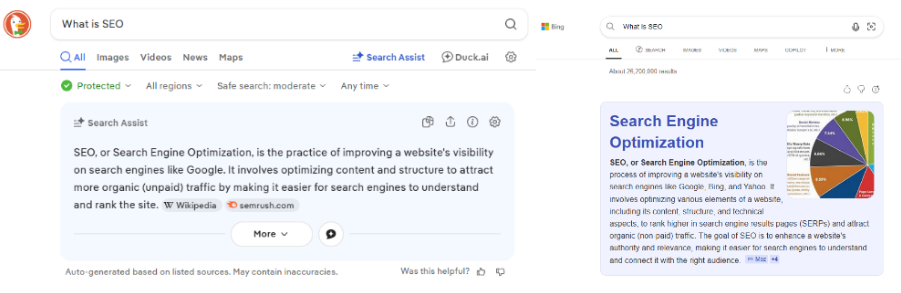
(DuckDuckGo & Bing’s AI-assisted search results.)
At the same time, AI platforms such as ChatGPT, Gemini, Perplexity, and similar tools are increasingly becoming direct sources of information. As users turn to these platforms for instant, synthesized answers, they gradually take a significant share of what used to be organic search traffic.
This rise in AI-generated answers has directly contributed to the growth of zero-click searches. Today, it is estimated that over 50% of searches result in no website clicks at all. Users receive their answers instantly from AI summaries, enriched snippets, or AI Overviews without ever visiting a website.
This raises an important question when it comes to optimizing for SEO in 2026: How do SEO professionals adapt when the search engine answers the query before a user ever reaches a website?
2. The AI-Theory vs. Real Expertise Gap
As is the case with any new SEO trend, and as AI becomes more central to search, the SEO community has seen (and will probably continue to see) a surge of ‘guaranteed’ strategies for ranking in AI Overviews and AI-driven results. While many of these ideas have value, most of them ultimately point back to the same foundational principles behind effective traditional SEO:
- High-quality, trustworthy content
- Strong E-E-A-T signals
- Clear authority
- Solid technical foundations
- A focus on user intent and usability
And Google itself reinforces this. In Google’s AI Overview and AI Mode documentation, they state:
“AI Overviews are built to surface information that is backed up by top web results, and include links to web content that supports the information presented in the overview.”
In other words:
Optimizing for AI Overviews is nearly the same as optimizing for traditional SEO.
If your website is already producing authoritative, well-structured, trustworthy content, you are naturally positioned to perform well in AI-generated results.
When it comes to AI platforms like Gemini, ChatGPT, and Perplexity, one of the most effective emerging approaches is understanding query fan-out, which is a technique where the AI breaks a single user question into multiple sub-queries, retrieves data across many sources, and then synthesizes these insights into a final, comprehensive answer.
To become more “AI-discoverable,” content must be:
- Deep
- Structured
- Factual
- Rich in entities
- Easy for models to parse and cite
Also, increasing your overall authority through quality backlinks and PR, while maintaining strong technical SEO (fast performance, clean structure, and proper indexing), remains a stable foundation.
AI search is still in its early stages, and over the coming years we expect clearer, more established optimization methods to emerge. But for now, the strongest approach remains simple: Follow the fundamentals, strengthen your expertise, and create content worth citing, whether by humans or machines.
3. YouTube & Social Media Becoming Increasingly Visible in SERPs
Another clear shift is the increasing visibility of YouTube and social media results within traditional search. Google is pulling more video, short-form content, and social signals into SERPs, which means traditional SEO now overlaps directly with YouTube SEO and social media optimization, further adding to SERP volatility.
Because of this, relying only on written content is no longer enough. You need to understand what users actually prefer to consume, whether that’s articles, videos, shorts, or posts, and optimize for that format.
Simply put: If your brand doesn’t reach users where they already are, you’re not truly visible.
4. Content Quality & Search Intent Become Even More Essential
For SEO in 2026, content quality (expressed through factors like E-E-A-T, information quality, originality, engageability, and more) and following search intent are expected to become even more essential as ranking factors. As AI-generated content becomes more widespread, Google is expected to lean even harder on signals of high-quality, original content, along with real genuine expertise, credibility, and a clear understanding of user intent.
This means that content written with purpose and genuineness (content that demonstrates actual experience, knowledge, value and actually serves the intent behind the user’s search) is expected to remain the backbone of strong SEO performance.
SEO in 2026 is less about “targeting keywords and mindlessly stuffing them” and more about matching user needs with trustworthy information that truly helps users.
5. Experienced-Based Titles
One noticeable trend appearing across search engines and especially YouTube is the rise of titles and hooks like:
- “I Did X So You Don’t Have To”
- “I Tried X For 30 Days—Here’s What Happened”
These types of formats are everywhere recently and whether they actually help in ranking is still unclear, but what is clear is that platforms are rewarding content that feels human, is attached to a unique voice or personality, and aims to help fellow humans. This trend reflects a broader pattern that is: SEO is slowly merging with content style, tone, and personality. Even factual content is expected to feel more unique.
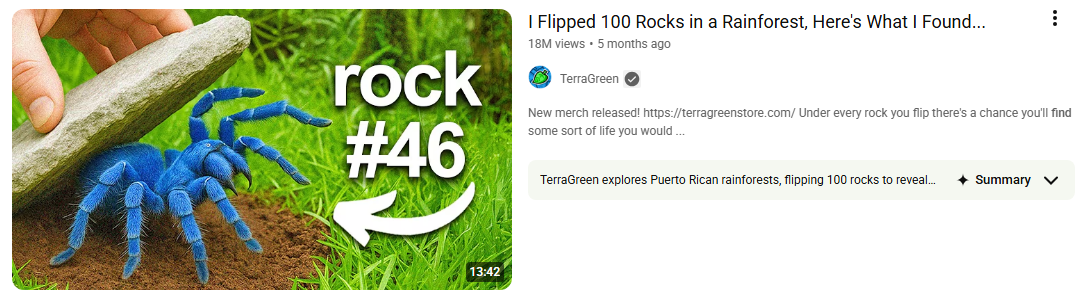
(YouTube / TerraGreen)
6. Human Content and the Rise of AI Slop
Following along with the topic of unique content and with the rapid growth of AI tools, much of the content being published online is starting to look and read the same:
 low effort, generic, repetitive, and sometimes very formally worded when it shouldn’t. This type of content actually has a word that describes it: “AI slop”.
For SEO professionals: well-written, thoughtful content (even if AI-assisted) could become more valuable simply due to the fact that everything else is getting worse. If search engines begin detecting and downranking low-effort AI output, higher-quality human-guided content should stand out even more.
7. Strengthening of Local SEO
Local SEO will likely grow even more central as mobile searches and location-based discovery continue to rise. As map results, local packs, and proximity signals play a larger role in search, appearing in local queries, Google Maps, and location-based searches becomes almost essential for businesses with physical locations or service areas.
Hopefully, we’ve shown that SEO in 2026 isn’t going anywhere. As you’ve seen throughout this article, optimizing for SEO in 2026 will look very similar to optimizing for SEO in 2025, with only a few shifts and new SEO trends.
Still, at its core, SEO rewards clarity, usefulness, and trust. The tools may evolve, search engines may shift toward AI, and zero-click results may rise, but the principle remains the same: create content worth discovering.
Looking for an agency that is up to date with the latest SEO trends? Contact us today and request a quotation!