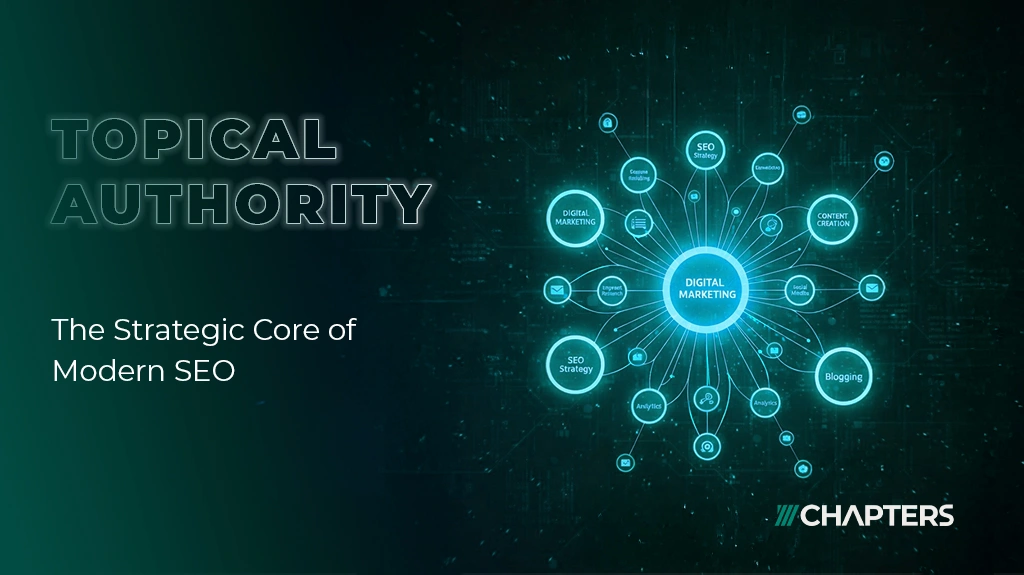


One of the beauties of SEO is that it introduces new challenges, new opportunities, and always keeps evolving. Yet despite these constant algorithmic shifts and the rise of AI-driven search, one principle remains a constant in nearly every high-performing SEO strategy: Authority building. For this article, we will focus on topical authority specifically.
If you’re asking “What is topical authority in SEO?” or trying to understand why search engines increasingly reward sites that demonstrate deep, structured expertise, you came to the right place.
This article breaks down exactly what topical authority is, why it has become so essential, how it differs from domain authority, and why it should be the centerpiece of every SEO strategy moving into 2026 and beyond.
What Is Topical Authority in SEO?
Topical authority is not just another SEO buzzword. It’s a foundation and the reason why some websites consistently outrank competitors regardless of backlinks or domain age.
Topical authority refers to a website’s ability to demonstrate complete, authoritative coverage of an entire subject area, not just isolated topics that stuff a certain keyword and call it a day.
When a site achieves topical authority:
- Google trusts it as an expert source
- Users rely on it for depth and accuracy
- Rankings become more stable, and often higher
- The site becomes a reference point for the topic as a whole
In simple terms:
You don’t rank because you wrote one great article , you rank because you wrote every article the user would need on that topic.
Building topical authority aligns with Google’s evolution from being keyword-based to entity-based understanding. The more comprehensively your website covers a topic, the more confidently Google can connect your domain to that topic within its Knowledge Graph.
Topical authority is the real-world SEO equivalent of becoming the teacher, creator, and curator of a certain subject.
Domain Authority vs. Topical Authority: The Real Difference
Although both are “Authority”, they represent very different forms of strength.
| Factor | Domain Authority (DA) | Topical Authority |
| What It Measures | Predicts overall ranking ability based on backlink strength | Measures depth, structure, semantic completeness, and E-E-A-T within a specific topic |
| Scope | Broad and generalized across an entire domain | Narrow and topic-specific |
| Dependence on Backlinks | Highly dependent on backlink profile | Can be strong even with fewer backlinks if topical coverage is comprehensive |
| Strengths | Shows domain-wide trust from external sites | Demonstrates mastery of a specific subject area |
| Weaknesses | Can be high even with weak or incomplete topic coverage | Requires significant work, planning, clustering, and maintenance |
| Competitive Advantage | Helps large, older websites maintain general authority | Allows smaller or newer websites to outrank giants by covering a niche deeply |
| Best Use Case | Evaluating general site credibility | Building relevance and visibility for niche topics or clusters |
Why Topical Authority Is Replacing Old Keyword-First SEO
For years, SEO practitioners built content around a list of keywords. But search engines have matured far beyond just keyword matching.
Search engines now look for:
- Whether your content demonstrates context
- Whether your coverage reflects real expertise
- Whether the user’s full intent is served , not partially answered
- Whether your site is semantically complete
And because AI Overviews and generative search models summarize content directly from topically authoritative sources and high ranking webpages, websites that lack complete coverage often disappear from result sets entirely, both on SERPs and AI.
This explains the new trend:
A website with 10 deeply connected articles can outrank a website with 20 superficial ones.
Today’s SEO is not about chasing keywords. It’s about becoming a topic expert.
Pillars & Cluster: The Base for Building Topical Authority
Topical authority does not happen accidentally. It requires a structured content structure that clearly communicates hierarchy, relevance, and depth. This is where the pillars and clusters come to play.
Pillar Pages = The “Full Guide” Type of Pages
These pages give a complete, high-level overview of a broad topic. They act as the authoritative hub , the “centerpiece”.
Cluster Pages = The “Deep-Dive” Type of Articles
Each cluster page targets one specific subtopic, intent, question, or angle.
Internal Links = The Roads
Internal linking reveals:
- What belongs together
- Which page is the primary source
- How hierarchy flows
- How authority should be distributed
Google uses this architecture to decide:
- Which page is the “parent” (most important)
- Which supporting pages reinforce expertise
- Whether the topic is complete
This architecture is a foundation for how search engines interpret expertise.
The Roundabout Analogy: How Topic Clusters Really Work
Imagine a roundabout:

The Center Circle = The Pillar Page
It collects authority from every cluster page (roads) and redistributes it (exits). It’s the page that Google sees as the definitive resource.
The Exits = Cluster Pages
Each exit represents a highly focused article that addresses a specific need or intent.
The Flow of Cars = Internal Links
The smoother the flow, the easier Google can navigate the entire cluster.
A chaotic roundabout = poor SEO. A well-organized roundabout = clean, authoritative topical structure.
This visual analogy reflects everything modern SEO is built on:
- Navigation
- Hierarchy
- Intent clarity
- Relevance
- Authority
When your content ecosystem works like a smooth roundabout, Google and users move effortlessly through your content.
E-E-A-T: The Trust Layer Behind Topical Authority
You cannot build topical authority without demonstrating Experience, Expertise, Authoritativeness, and Trustworthiness or Simply called “E-E-A-T”.
Even if your content cluster is technically perfect, Google still evaluates:
Experience
Have you actually done, used, tested, or applied what you’re teaching?
Expertise
Does your site show deep understanding, supported by clear, accurate explanations?
Authoritativeness
Do external websites reference you, cite you, or link to you as a reliable source?
Trustworthiness
Is your site secure, transparent, credible, and user-focused?
Proving to search engines that your content is trustworthy is the ultimate goal and building topical authority is the way to achieve that goal.
Semantic Relevance: Why Google Focuses on Meaning and Intent, Not Keywords
Search engines have moved fully into conceptual, intent-driven, entity-aware retrieval. This is why topical authority matters so much.
Google analyzes:
- The entities in your content
- How these entities relate to each other
- Whether your content matches user intent
- Whether your page completes the conceptual topic
Your content is no longer judged as isolated pages; it’s understood as part of a semantic network.
If your cluster reflects everything a user needs to know about the topic, you win.
If your cluster is shallow or incomplete, Google chooses someone else.
How to Build Topical Authority in SEO
Topical authority requires deliberate, strategic, and long-term execution.
Step 1: Conduct Deep, Holistic Keyword & Topic Research
You’re not looking for random keywords , you’re deliberately researching a topic and finding relevant keywords that would cover the topic and simultaneously help users.
This includes:
- all core concepts
- all subtopics
- all angles of the topic
- all related entities
- all pain points
- all user intents
- all People Also Ask questions
- all missing knowledge gaps
Your goal: Identify every possible question a user might ask.
Step 2: Analyze SERPs for Intent, Structure & Dominant Patterns
For each keyword group:
- Look at top-ranking pages
- Identify what format Google prefers (guide, list, video, tool, comparison)
- Study PAA questions
- Study related searches
- Note the content depth competitors use
- Analyze page structure and internal linking
But don’t copy competitors , identify what users repeatedly need and try to cover users pain points from different angles and offer new perspectives on the matter.
Step 3: Identify All Content Gaps
Content gaps typically fall into four categories:
- Missing pages → topics your audience needs but your site doesn’t cover
- Depth gaps → existing pages that are too shallow to compete
- Intent mismatch → pages that don’t match what users actually want
- Semantic gaps → missing entities, concepts, or relationships
Gaps make it difficult to earn topical authority, no matter how many articles you publish.
Step 4: Keyword & Topic Mapping (Avoiding Cannibalization)
This step is where many SEO strategies fall apart.
Mapping ensures:
- each page has a single purpose
- each cluster covers a full intent
- each keyword group belongs to the right parent topic
- the cluster does not internally compete
- the pillar clearly outranks its children
Mapping is the blueprint that keeps your topical architecture clean.
Step 5: Strategic Content Production (The Core of Topical Authority)
Here is the detailed execution:
A. One Intent = One Page
Do not merge unrelated intents. Do not split a single intent into multiple pages.
B. Build the Pillar First, Then the Cluster
The pillar sets the direction; clusters enrich it.
C. Follow Semantic Completion
Your content should:
- define
- explain
- compare
- provide examples
- answer FAQs
- include entities
- connect related concepts
- offer practical steps
D. Use Internal Links Intentionally
Every cluster page should link:
- back to the pillar
- to related cluster pages
- to deeper subtopic pages
E. Use Descriptive Anchor Text
Generic anchors (“read more, ” “click here”) weaken semantic signals.
Use:
- “learn technical SEO fundamentals”
- “internal linking strategies for topical authority”
- “pillar–cluster content architecture”
Internal linking is where topical authority becomes visible to Google’s crawlers.
Step 6: Reinforce E-E-A-T Throughout Your Cluster
Use:
- expert commentary
- first-hand experience
- case studies
- data and benchmarks
- real examples
- authorship transparency
- citations to reputable sources
Step 7: Maintain, Update & Expand the Topic Ecosystem
Topical authority is earned and maintained, not achieved once.
Keep improving:
- add missing content
- update outdated sections
- refine semantics
- adjust based on SERP changes
- add FAQs
- strengthen internal linking
- expand with new subtopics
Becoming a topical authority is not a one-time sprint. It’s a continuous, structured ecosystem.
Topical Authority Isn’t a Silver Bullet, It Compounds Over Time
Search engines are moving toward AI reasoning, entity understanding, and contextual evaluation.
In this environment, topical authority is a strong long-term ranking strategy that you can invest in.
When you build a content ecosystem, not scattered articles, you rise above competitors who still rely on outdated, keyword-first SEO.
Looking for an SEO agency to help you outrank your competitors? Chapters has you covered. Request a quotation today!