

AI Overviews are no longer a test or an experiment. They’re a visible part of how we search, read, and get information online, whether we like it or not. Be it a casual user, a business owner, or an SEO professional, AI Overviews have already reshaped search behavior in ways that are impossible to ignore. In this article, we will provide a practical breakdown of what AI Overviews are, why they matter, where they fall short, and how to adapt without chasing “guru hacks” and shortcuts.
What Are AI Overviews? (A Brief History and Explanation)
AI Overviews are AI-generated summaries that appear at the top of Google search results for certain queries. Their goal is to give users a quick, structured answer pulled from multiple web sources, with links included for deeper exploration.
The feature originally launched as Search Generative Experience (SGE) and was officially introduced as AI Overviews at Google I/O 2024. Unlike chatbots, AI Overviews aren’t a separate product, they’re built directly into Google Search.
Behind the scenes, they rely (based on Google’s AI overviews and AI mode documentation) on a mix of:
- Google’s Gemini AI models
- Traditional ranking systems
- The Google Knowledge Graph
- Public web content (with citations)
In short:
AI Overviews summarize the web inside search results. They don’t replace websites, but they do change how websites are discovered and shown.
AI Overviews Citations: A Real Example
In our SEO in 2026 trends predictions, we predicted that the AI overviews (Along with other AI platforms) are going to dominate the search landscape, we also mentioned that there is a real gap between theory and practice when it comes to AI overviews SEO.
Since AI Overviews usually cite multiple sources, you might expect the top organic results to always be the primary references. In practice, this isn’t always the case.
In the example shown below, a Reddit post is cited above Google’s own SEO Starter Guide, even though the Starter Guide appears as the top-ranking organic result.
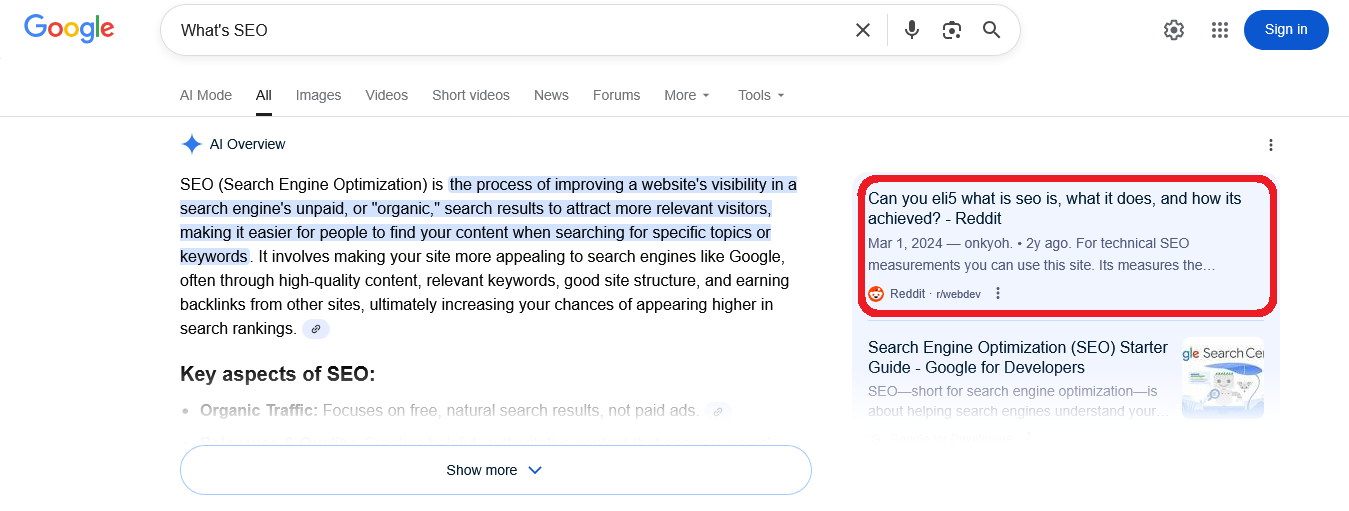
A likely explanation is that AI Overviews (and LLMs in general) often prioritize direct, experience-based content, especially from forums like Reddit and Quora. These platforms tend to provide:
- First-hand explanations
- Natural, conversational answers
- Context that reflects real user experience
This suggests that AI citation logic is not purely rank-based. Instead, it appears to balance authority with perceived usefulness and authenticity.
Advantages & Disadvantages of AI Overviews
In this section, we are going to present the upsides and downsides of AI overviews, for both users and SEO professionals.
The Upsides
For users
- Faster understanding of complex topics
- Fewer searches needed to learn something
- Clear entry points that allows further explorations multiple sources
For SEO professionals and website owners
- Visibility beyond traditional blue links
- Brand exposure even without a click
In many cases, AI Overviews SEO is not necessarily about winning the click, it’s about being cited and gaining awareness.
The Downsides (And Why They’re Controversial)
AI Overviews are helpful, but far from perfect.
- Traffic impact
By answering questions directly, AI Overviews can reduce clicks, especially for informational publishers. This raised real concerns about long-term sustainability for content-driven websites. - Source misrepresentation
Even when citations are included, summaries can oversimplify or distort the original meaning of the source content. - Laugh-worthy summaries
Some AI Overview answers went viral for being confidently wrong, unsafe, or unable to distinguish jokes from serious answers. All of this has sparked a wave of AI overview memes wave across social media. - Legal and ethical questions
Publishers and regulators have raised concerns around content usage, consent, compensation, and market dominance. Prompting investigations and lawsuits. - “How do I get rid of them?”
One of the most searched questions about AI overviews is how to disable them.
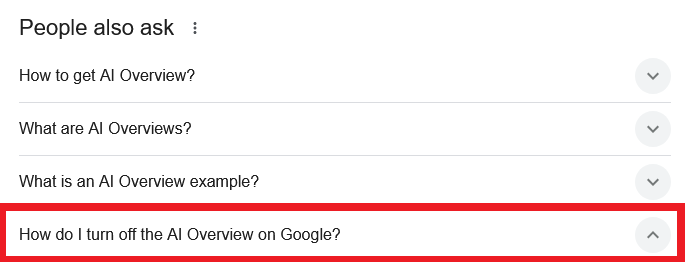 That alone says a lot about how controversial and polarizing they’ve become.
How AI Overviews Changed SEO
- In the early days of SEO, a lot of professionals relied on informational content to gain clicks and traffic, aiming to persuade users to engage within the websites. A major goal was securing the top-most result or getting featured in the Featured Snippet.
| Area of Focus | Key Metrics & Goals |
| Visibility Goal | Appearing as the Top Result and getting the Featured Snippet. |
| Primary Content Type | Informational content to gain traffic. |
| Key Metrics |
|
AI Overviews SEO Focus (Current Shift)
- AI Overviews now nearly dominate informational keywords, often replacing the need for a click. Thankfully, AI Overviews do not appear nearly as much for commercial and transactional keywords, which usually prompt Local Packs (Maps) and direct results. For AI overviews SEO the focus has shifted toward building authority, credibility, and clear content.
| Area of Focus | Key Strategies & Goals |
| New Visibility Goal | Visibility (being the source for the AI Overview). |
| Key Strategies |
|
With AI Overviews, SEO is no longer only about rankings and traffic. Being cited in AI results has now joined the equation
How to Rank in AI Overviews (And Make the Most of Them)
When it comes to AI overviews SEO, If you are looking for easy hacks, sadly there’re no easy hacks, and anyone claiming otherwise is probably guessing.
What actually works:
1. Get the fundamentals right
Strong technical SEO, clean architecture, fast performance, and crawlable content still matter.
2. Write for real questions
AI Overviews appear most often for:
- Informational searches
- “How”, “Why”, and comparison queries
- Multi-step or nuanced topics
3. Structure content clearly
Use:
- Clear headings
- Bullet points
- Concise paragraphs
- Direct answers near the top
This makes your content easier to interpret and summarize.
4. Demonstrate E-E-A-T
Focus on:
- Accuracy
- First-hand insight where relevant
- Credible sources
- Clear authorship and brand trust
If you want to learn more about E-E-A-T, check out our blog: E-E-A-T Standards in 2026: What It Really Means for Your SEO Content Strategy
5. Think in topics, not isolated pages
AI Overviews rely on context. Content that covers a topic comprehensively is more likely to be selected than thin, disconnected pages.
6. Accept that visibility doesn’t always mean clicks
Being cited in an AI Overview is still a win. Brand exposure, trust, and recall matter too.
What Does AI Overviews Mean for SEO.
AI Overviews didn’t kill SEO, they evolved it.
They reward:
- Clear thinking
- Real expertise
- Helpful structure
- User-first content
They punish:
- Clickbait
- Thin content
- Shortcuts
Whether you like them or not, AI overviews are here to stay. The smart move isn’t fighting the change, it’s adapting with clarity and solid fundamentals. SEO has always evolved.
AI Overviews are simply the next chapter.
If you are looking to write your next SEO chapter successfully, Chapters Digital Solutions has you covered. Request a quotation today!