

Have you ever landed on a website and felt like it was speaking a completely different language? You’re searching for winter coats, but you’re being bombarded with ads for summer sandals. This digital disconnect is the hallmark of an outdated, one-size-fits-all user experience (UX). In today’s hyper-competitive market, where customer attention is the most valuable currency, such generic interactions are not just frustrating for the user—they are fatal for business.
As we stand on the cusp of 2026, the era of passive, static web pages is definitively over. The new benchmark for digital excellence is hyper-personalization, a strategy that treats every user as an individual with unique needs, preferences, and intent. The driving force behind this revolution? The powerful and transformative synergy of AI personalization for User Experience (UX) design.
This isn’t science fiction. It’s the new reality of digital marketing and customer engagement. AI is no longer just a buzzword; it’s the engine that powers deeply relevant, predictive, and adaptive experiences at a scale previously unimaginable. This in-depth post will explore the profound impact of AI on UX personalization, dissecting how it works, the tangible business benefits it delivers, and how you can strategically implement it. Welcome to the next chapter of digital interaction.
Beyond Basic Personalization: The Dawn of the Hyper-Personalized Era
To truly appreciate the leap forward that AI represents, we must first understand the limitations of past approaches. Personalization itself is not a new concept, but its execution has evolved dramatically.
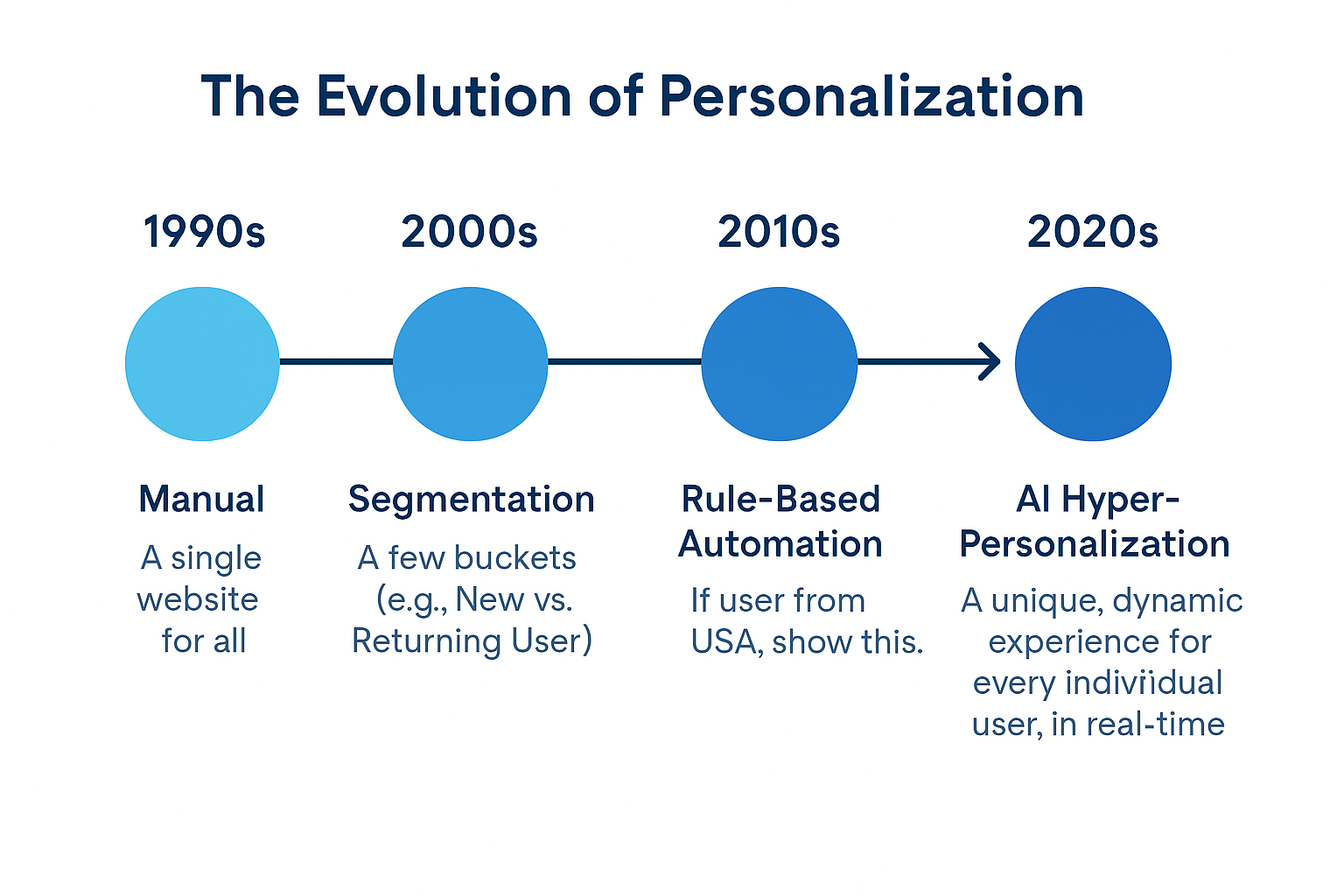
The Old Way: Rule-Based Segmentation
For years, personalization was synonymous with segmentation. Marketers would manually group their audience based on broad, static criteria. Think of it as creating a few large buckets:
- Demographic Segmentation: Grouping users by age, gender, or location (e.g., “Show this banner to all users in London”).
- Behavioral Segmentation: Grouping users by past actions (e.g., “Send this email to everyone who purchased Product X”).
This rule-based system, often using “if-then” logic, was a step up from a completely uniform experience. However, it was fundamentally flawed. It was rigid, requiring constant manual updates. It couldn’t adapt in real-time to a user’s changing intent, and its broad-stroke approach often missed the nuances of individual preference. A user from London might be a tourist interested in souvenirs, not a local looking for a new bank. Rule-based segmentation could never tell the difference.
The New Frontier: AI-Powered Hyper-Personalization
Enter AI-powered hyper-personalization. This is not just a better version of segmentation; it’s a paradigm shift. Hyper-personalization aims to create a unique, 1:1 experience for every single user, in real-time. It moves beyond reacting to past behaviors and starts predicting future needs.
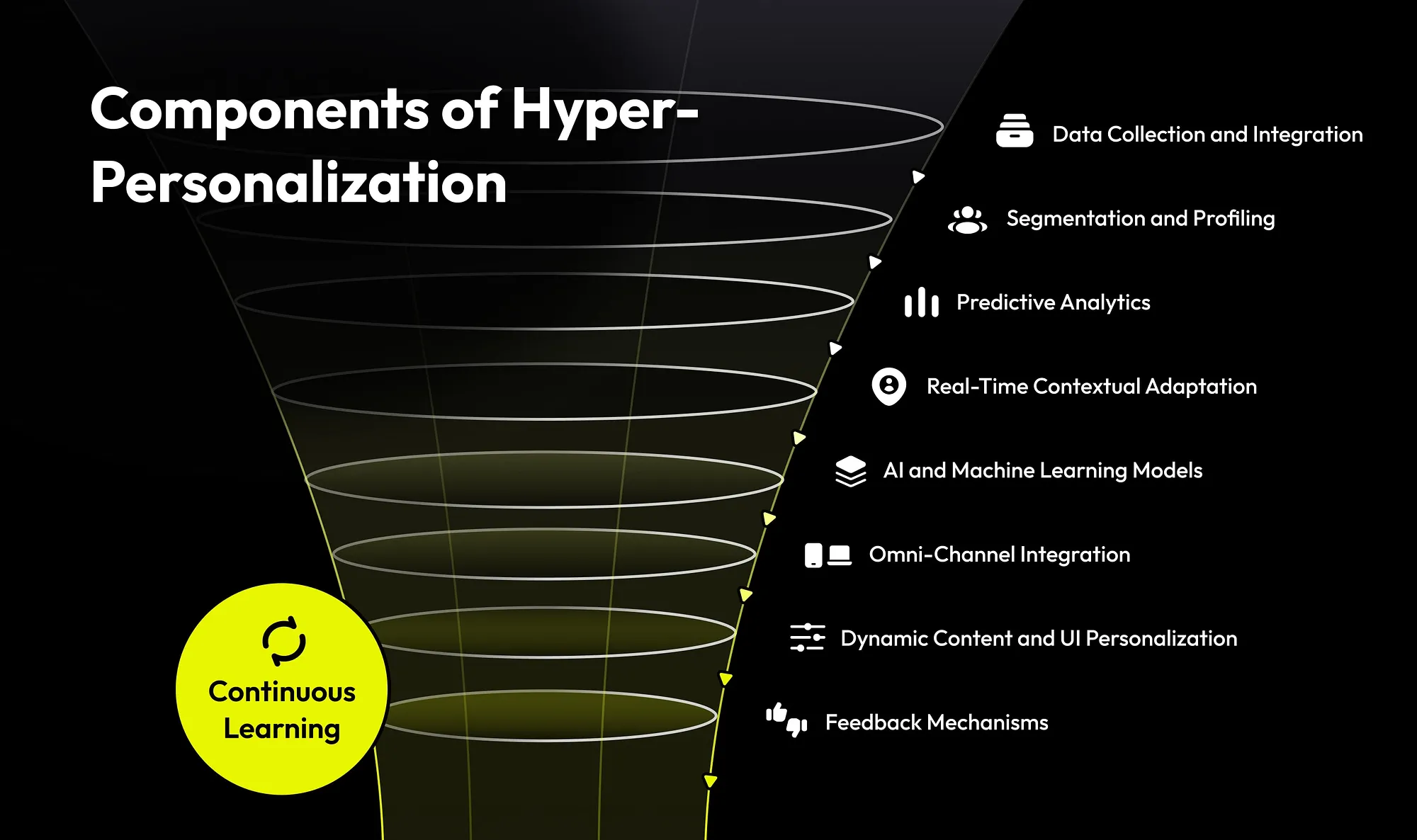
How does AI achieve this? Through machine learning (ML) algorithms that can analyze colossal, multi-dimensional datasets in milliseconds. Instead of a few large buckets, AI creates a “segment of one.” It considers not just who you are and what you’ve done, but also the context of your current visit: the time of day, the device you’re using, your real-time browsing behavior, and even your scroll speed. It synthesizes this information to understand your immediate intent and dynamically tailor the experience to match it.
The Engine Room: How AI Actually Personalizes User Experience
To demystify the “magic” of AI, let’s break down the core technical components that work behind the scenes to create these seamless, personalized journeys. It’s a sophisticated, multi-stage process that turns raw data into relevant experiences.
1. Data Collection & Unification
AI is insatiably hungry for data. The more high-quality data it has, the more accurate its predictions and the more relevant its personalizations. The process begins by collecting data from a multitude of sources:
- Behavioral Data: This is the digital footprint a user leaves. It includes pages viewed, time spent on page, clicks, scroll depth, items added to cart, and search queries.
- Transactional Data: Past purchase history, average order value, frequency of purchase, and product categories of interest.
- Demographic Data: Information like age, location, and language, often provided by the user or inferred.
- Contextual Data: Real-time information such as the user’s device (mobile vs. desktop), browser, time of day, and even weather at their location.
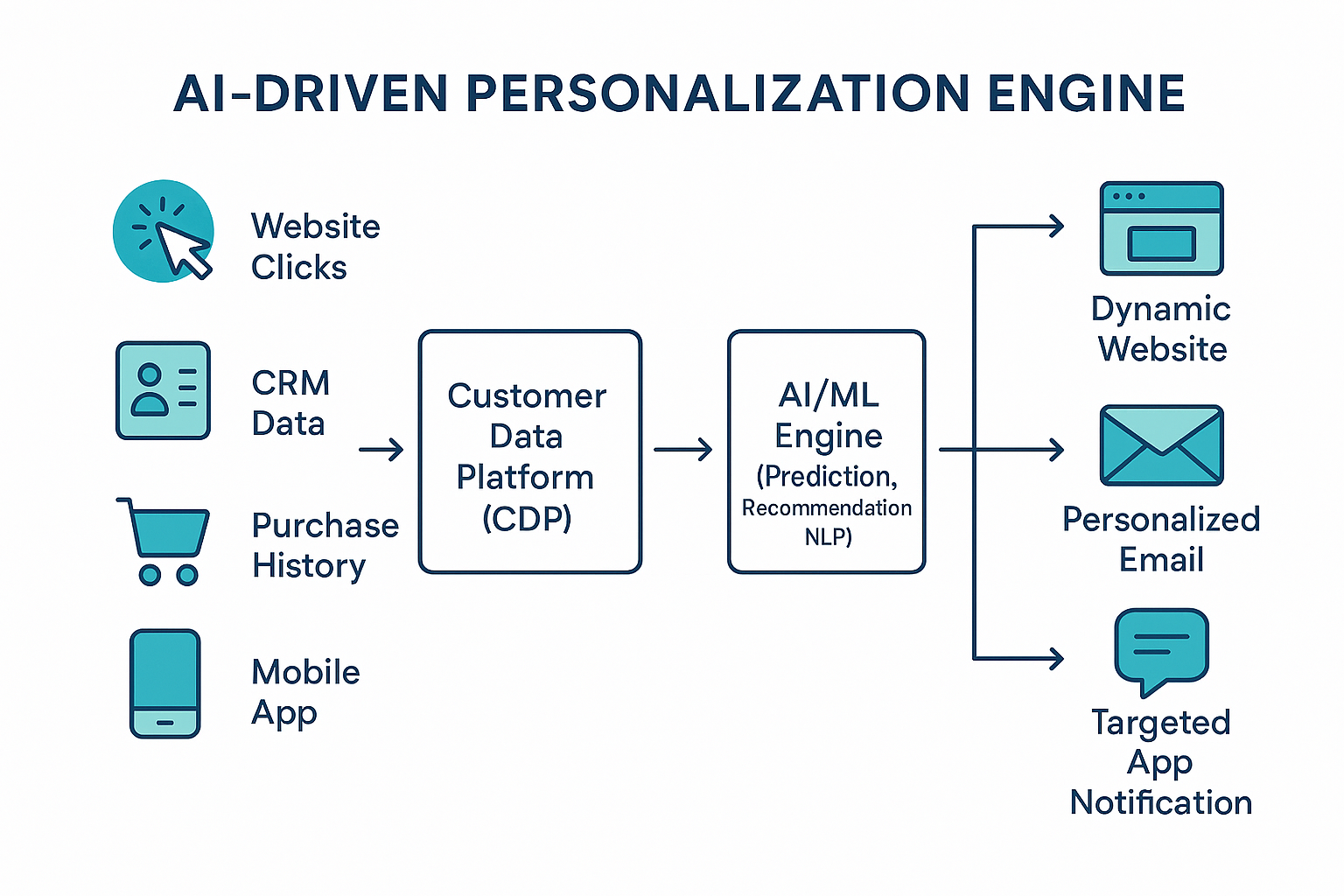
The critical challenge here is that this data often lives in separate silos (CRM, e-commerce platform, analytics tools). This is where a Customer Data Platform (CDP) becomes indispensable. A CDP acts as the central nervous system, ingesting data from all these sources and stitching it together to create a single, unified, and persistent profile for each customer. This unified view is the foundational fuel for the AI engine.
2. Machine Learning Models at Work
With a rich, unified data source, machine learning models can get to work. These are not simple “if-then” rules but complex algorithms that learn and improve over time.
- Predictive Analytics: These models analyze past data to forecast future outcomes. For example, an e-commerce site can use a predictive model to assign a “churn risk score” to customers who haven’t purchased in a while, allowing the system to proactively target them with a special offer. Another model might predict the “likelihood to convert” for a new visitor in real-time, deciding whether to show them a discount to nudge them towards a purchase.
- Recommendation Engines: This is one of the most visible applications of AI in UX. Giants like Netflix and Amazon have built their empires on this. The two main types are:
- Collaborative Filtering: This works on the principle of “people like you also liked…”. It finds users with similar tastes and recommends items that others in that group have enjoyed.
- Content-Based Filtering: This recommends items based on their attributes. If you consistently watch action movies, it will recommend more action movies (“because you watched…”). A sophisticated system combines both methods for highly accurate suggestions.
- Natural Language Processing (NLP): NLP gives AI the ability to understand and respond to human language. This powers intelligent chatbots that can handle complex customer service queries, voice search optimization that understands conversational requests, and sentiment analysis that can scan thousands of product reviews to gauge overall customer feeling.
3. Dynamic Content & Interface Optimization
The final step is to translate the AI’s insights into a tangible change in the user experience. This is where the website or app becomes a living, breathing entity that adapts to each user.
- Dynamic Content: Instead of a static homepage, an AI-powered site can dynamically change every element. The hero banner might feature a product category the user has shown interest in. The blog section might highlight articles relevant to their industry. Even the call-to-action (CTA) buttons can change—a new visitor might see “Learn More,” while a returning customer sees “View Your Loyalty Points.”
- AI-Powered Testing: Traditional A/B testing, where you test one variation against another, is slow and limited. AI introduces concepts like Multi-Armed Bandit algorithms. Instead of splitting traffic 50/50 for the entire test duration, the algorithm quickly learns which variation is performing better and dynamically allocates more traffic to the “winner” in real-time, maximizing conversions even while the test is running. It can also test dozens of combinations of headlines, images, and colors simultaneously to find the optimal layout for different user segments.
More Than Just a “Cool Feature”: The ROI of AI-Personalized UX
Implementing an AI-driven personalization strategy is a significant investment, but the returns are substantial and impact every key business metric. This is not about superficial tweaks; it’s about fundamentally improving the customer relationship and driving measurable growth.
“Personalization works. According to McKinsey, companies that excel at personalization generate 40% more revenue from those activities than average players. As we move into 2026, this gap between leaders and laggards will only widen.”
Skyrocketing Engagement and Retention
When a user feels that an experience is tailored for them, they are naturally more engaged. A relevant experience is a valuable one. Instead of bouncing after a few seconds, users are more likely to explore, click, and consume content. This increased “time on site” and “pages per session” are strong indicators of user satisfaction. More importantly, this positive experience builds a habit. Users are far more likely to return to a site that understands them, dramatically boosting customer retention rates and lifetime value (LTV). A retained customer is infinitely more valuable than a newly acquired one.
Boosting Conversion Rates and Average Order Value (AOV)
This is where AI personalization directly impacts the bottom line. By removing friction and proactively guiding users toward what they want, conversion rates see a significant lift. Consider an e-commerce example: a user is looking at a specific laptop. An AI-powered system doesn’t just show random “bestsellers”; it shows a compatible mouse, a carrying case that fits the laptop’s dimensions, and a software bundle that other laptop buyers frequently purchased. This intelligent cross-selling and up-selling, powered by recommendation engines, is a primary driver of increased Average Order Value (AOV). The path from browsing to purchase becomes shorter, more intuitive, and more profitable.
Enhancing Customer Loyalty and Brand Affinity
In the long run, the most profound benefit of AI-driven UX is the cultivation of genuine brand loyalty. Personalization transcends the transactional nature of business. It sends a powerful message to the customer: “We see you, we understand you, and we value you.” This emotional connection is the bedrock of a strong brand. When customers feel valued, they become more than just purchasers; they become advocates. They are more forgiving of occasional mistakes, more likely to leave positive reviews, and more inclined to recommend your brand to others. This affinity is a competitive moat that is incredibly difficult for competitors to overcome.
Case Study in Action: How “StellarStyle” Transformed Its UX with AI
To make these concepts concrete, let’s look at a simplified case study of a fictional online fashion retailer, “StellarStyle.”
The Challenge
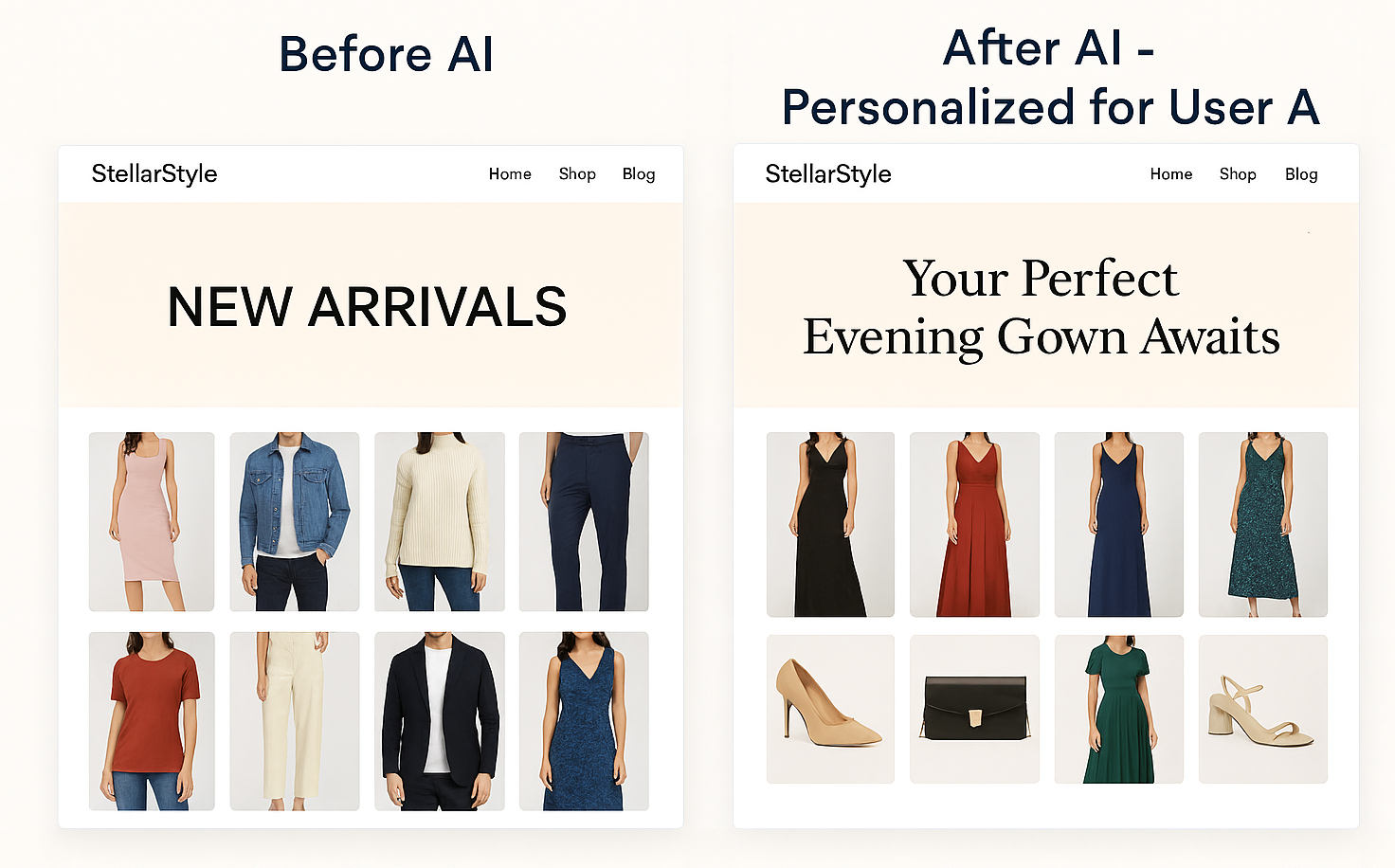
StellarStyle was a mid-sized e-commerce brand with a stylish product line and healthy website traffic driven by social media. However, their business metrics were stagnating. They faced a high bounce rate (over 60%), a low conversion rate (1.5%), and a cart abandonment rate that was creeping towards 75%. Their website experience was completely generic. Every visitor, whether a 19-year-old student looking for party dresses or a 45-year-old professional searching for workwear, saw the exact same homepage featuring “New Arrivals” and “General Bestsellers.” The user journey was full of friction.
The AI-Powered Solution
StellarStyle partnered with a digital strategy firm (like Chapters Digital Solutions) to implement a comprehensive AI personalization engine. The goal was to make every user’s shopping experience feel like a personal styling session. They focused on three key areas:
- Personalized Homepage Journey: The static homepage was replaced with a dynamic grid. The AI analyzed a user’s browsing history, past purchases, and even real-time clicks. A user who had previously looked at “men’s sneakers” would now see a hero banner for the latest sneaker drop and product blocks featuring athletic wear. A user who had browsed “women’s formal wear” would see elegant dresses and accessories.
- Hyper-Relevant Product Recommendations: The generic “You Might Also Like” sections on product pages were supercharged. The new system, using a hybrid recommendation model, showed items that were not just stylistically similar but also frequently bought together. Viewing a blue dress would now trigger recommendations for matching shoes and a handbag from the new collection.
- Predictive Search and Exit-Intent Offers: The search bar began offering personalized suggestions as the user typed, based on their profile and trending items within their preferred categories. Furthermore, an AI-powered exit-intent model was deployed. If a high-value user with items in their cart moved their cursor to exit the page, a targeted pop-up would appear offering a small, time-sensitive discount or free shipping to prevent cart abandonment.
The Results
The impact was transformative and measurable within six months:
- The conversion rate increased by 32%, from 1.5% to nearly 2.0%.
- Average Order Value (AOV) grew by 18% as users discovered and purchased more relevant cross-sell items.
- The cart abandonment rate dropped by 25%, thanks to the timely and personalized exit-intent offers.
- User engagement metrics soared, with time on site increasing by 45% and bounce rate falling to 35%.
StellarStyle didn’t just sell more clothes; they built a more loyal customer base who felt understood and catered to, turning a generic store into a personal boutique.
The Personalization Paradox: Navigating Ethics and Privacy
No discussion of AI personalization is complete without addressing the critical topic of ethics and privacy. There is a fine line between a helpful, personalized experience and an intrusive, “creepy” one. The power of AI comes with immense responsibility, and building and maintaining customer trust is paramount.
The “Creepy” Line: Personalization vs. Intrusion
Users are increasingly aware that their data is being used to tailor experiences. They appreciate when a service remembers their preferences, but they are alarmed when it seems to know too much. The “creepy” line is crossed when personalization feels like surveillance. For example, recommending a product based on a user’s browsing history is helpful. Referencing a specific detail from a private email or conversation in an ad is an unacceptable intrusion. The goal of AI should be to infer intent and preference, not to parrot back private data to the user.
Building Trust Through Transparency and Control
The antidote to “creepiness” is a proactive strategy built on trust. This involves two key principles:
- Radical Transparency: Businesses must be crystal clear about what data they are collecting, why they are collecting it, and how it is being used to improve the user’s experience. This information should not be buried in a 50-page legal document. It should be accessible, easy to understand, and presented in plain language within the privacy policy and at relevant data collection points.
- User Control: The ultimate power must rest with the user. Customers should have easy access to a “personalization dashboard” where they can view their data profile, correct inaccuracies, and opt-out of certain types of data collection or personalization altogether. Providing this control demonstrates respect for the user’s autonomy and builds immense trust.
The Future is Personal: Are You Ready to Write Your Next Chapter?
As we’ve explored, the integration of AI personalization into UX is not a distant future trend—it is the defining characteristic of successful digital businesses today and a non-negotiable for 2026. It’s the key to unlocking deeper engagement, higher conversions, and unbreakable brand loyalty. The question is no longer *if* you should adopt AI-driven personalization, but *how* and *how quickly*.
Implementing a sophisticated AI strategy that harmonizes data science, UX design, ethical considerations, and marketing goals can be a complex undertaking. It requires specialized expertise and a clear, strategic vision.
That’s where Chapters Digital Marketing Agency comes in. We are not just another marketing agency; we are your strategic partners in navigating the digital frontier. Our team of data scientists, UX designers, and marketing strategists specializes in crafting bespoke AI personalization roadmaps that respect user privacy while delivering exceptional, measurable results. We help you turn data into dialogue, and visitors into loyal advocates.
Ready to stop providing a one-size-fits-all experience and start building personal relationships at scale? Ready to write your brand’s next great success story?
Contact Chapters Digital Solutions for a Consultation Today