
In the past, SEO success was often measured by how many keywords a page ranked for. Today, that mindset is not only outdated, but it’s actively limiting growth.
Modern search engines no longer reward isolated keyword targeting. They reward semantic understanding, topical relevance, and clear information architecture. This is where semantic clustering becomes the foundation of scalable, future-proof SEO.
This article breaks down what semantic clustering really is, how it differs from traditional SEO, how we implement it across regional and international brands, and what it means for your business performance — not just rankings.
What Is Semantic Clustering?
Definition
Semantic clustering is the process of organizing content around meaning, entities, and search intent, rather than individual keywords.
Instead of asking:
“Which keyword should this page rank for?”
Semantic clustering asks:
“Which topic does this page fully represent — and how does it connect to the rest of the site?”
Why It Matters
Search engines like Google operate on entity-based SEO. They don’t evaluate pages in isolation they evaluate how well your entire site demonstrates topical authority and contextual relevance.
Semantic clustering:
- Helps search engines understand what your site is about
- Reduces keyword cannibalization
- Improves crawl efficiency and internal PageRank flow
- Aligns content with real user intent, not just queries
When Businesses Should Care
You should care about semantic clustering if:
- Your blog traffic is growing but conversions are not
- Rankings fluctuate heavily after core updates
- Multiple pages compete for the same keywords
- You plan to scale content, services, or locations
- You want long-term authority, not short-term wins
In our SEO audits, over 70% of underperforming sites suffer from poor semantic structure, not poor content quality.
Semantic Clustering vs Traditional Keyword Targeting
Diagram 1: Semantic Clustering vs Traditional Keyword Targeting
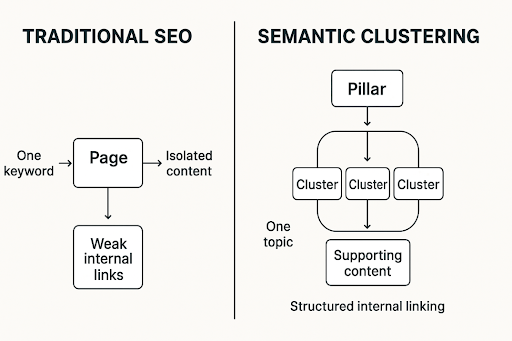
Traditional SEO focuses on:
- One keyword = one page
- Exact-match optimization
- Flat blog structures
- Minimal internal linking logic
Semantic clustering focuses on:
- One topic = multiple intent-based pages
- Entity coverage, not repetition
- Pillar–cluster relationships
- Strategic internal linking based on hierarchy
Why Traditional Keyword SEO Breaks at Scale
Across multiple client accounts, we observed that once a site crosses 150–200 indexed pages, traditional keyword targeting leads to:
- Cannibalization
- Thin content expansion
- Confusing crawl paths
- Diluted topical signals
Semantic clustering solves this by creating clear topical boundaries and intent-driven content roles.
Key Concepts You Must Understand (Mandatory Definitions)
Semantic Keyword Clusters
What it is:
A group of keywords connected by meaning, not just phrasing.
Why it matters:
Google ranks pages based on semantic coverage, not keyword frequency.
When to care:
When expanding content within the same service, product, or topic.
Topical Authority
What it is:
Your site’s perceived expertise on a topic, based on depth, structure, and consistency.
Why it matters:
Sites with strong topical authority rank faster and recover better from updates.
When to care:
If you want sustainable rankings without relying heavily on backlinks.
Topical Maps
What it is:
A strategic blueprint that defines:
- Core topics
- Subtopics
- Supporting content
- Internal linking logic
Why it matters:
It prevents random content creation and ensures every page has a role.
When to care:
Before scaling blogs, resources, or multi-service sites.
SEO Information Architecture
What it is:
How content is structured, connected, and prioritized across the site.
Why it matters:
Poor IA blocks crawl efficiency and weakens authority signals.
When to care:
During site launches, migrations, or content expansions.
Search Intent Mapping
What it is:
Aligning content types with why users search not just what they type.
Why it matters:
Ranking without intent alignment leads to low CTR and conversions.
When to care:
Always — especially for commercial and transactional keywords.
How Search Engines Actually Process Semantic Clusters
Search engines don’t evaluate pages in isolation. They rely on contextual relationships, crawl paths, and hierarchy signals, which means semantic clustering only works at scale when it’s supported by a clear seo information architecture that defines how topics, subtopics, and intent layers connect across the site.
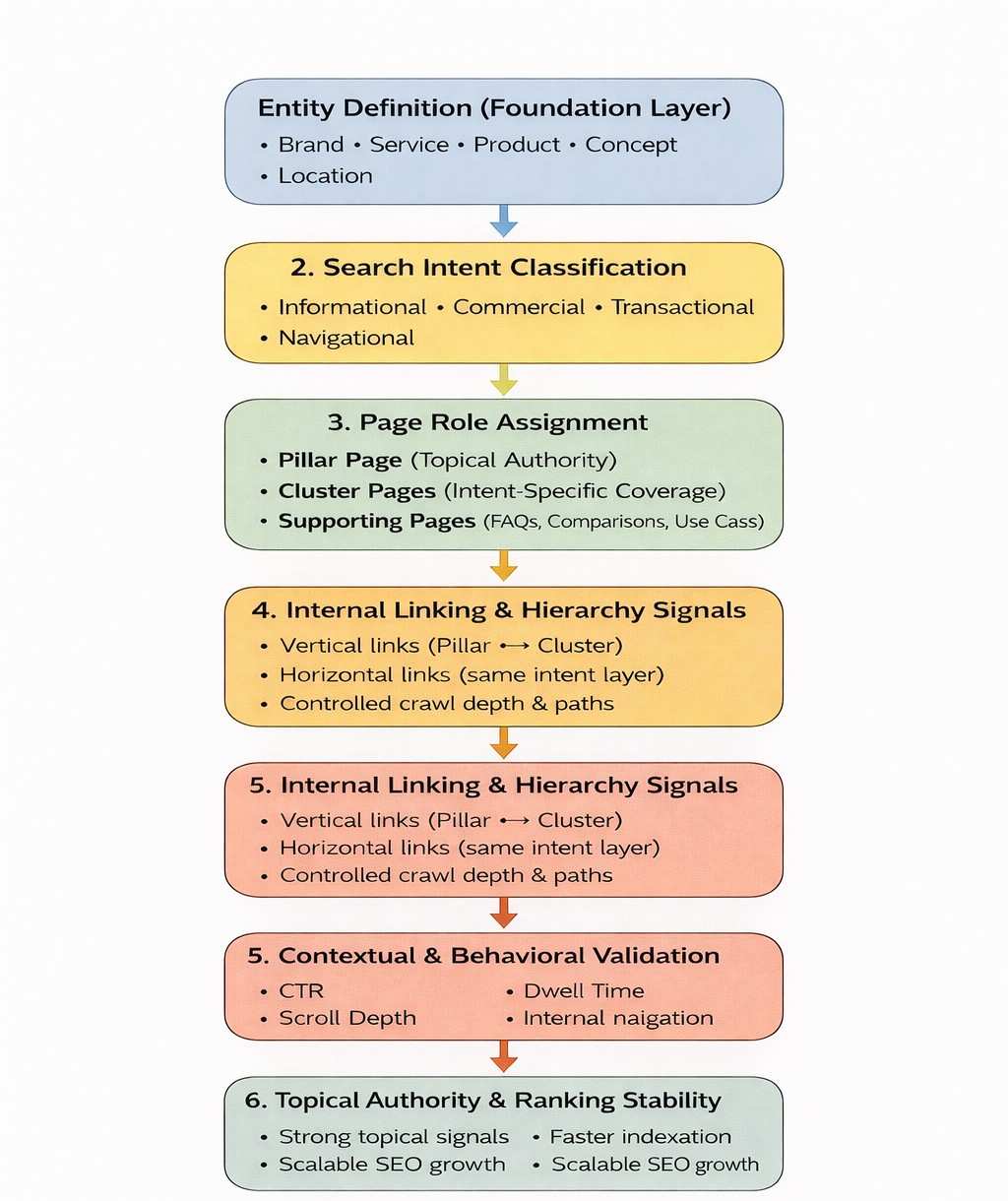
Diagram 4: Search Intent → Entity → Content Mapping
From a Digital Strategist’s perspective, modern SEO follows this sequence:
- Entity definition
- Intent classification
- Page role assignment (pillar/cluster/supporting)
- Internal linking & hierarchy
- Behavioral validation
- Stable rankings/authority (outcome)
If your content does not clearly map to this flow, rankings become unstable.
How Chapters Builds Semantic Clusters (Our Actual Methodology)
Step 1: Keyword → Entity → Intent Analysis
We don’t start with keywords alone.
We start by identifying:
- Primary entities (e.g. “SEO architecture”, “content hubs”)
- Supporting entities (tools, methods, frameworks)
- Intent layers per entity
In our audits, pages optimized without entity clarity underperform by ~30–40% in CTR compared to entity-aligned pages (based on internal benchmarks across B2B and SaaS sites).
Step 2: Topical Map Design
At this stage, we translate research into Topical Maps that define the full scope of a topic, clarify entity relationships, and prevent content overlap before a single page is published.
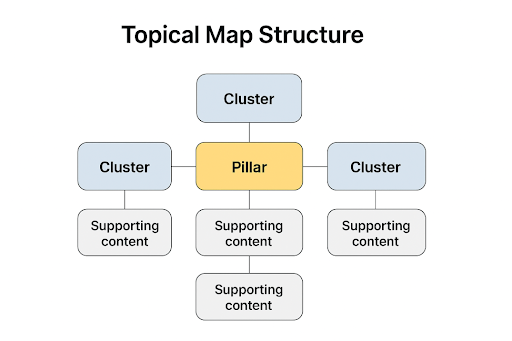
Diagram 2: Topical Map Structure (Pillar → Cluster → Supporting Pages)
Each topical map includes:
- Pillar page (core topic authority)
- Cluster pages (subtopics, intent variations)
- Supporting pages (FAQs, use cases, comparisons)
This ensures:
- Clear hierarchy
- Predictable internal linking
- Scalable content planning
Step 3: Pillar–Cluster Execution Model
Observed Pattern (Across Multiple Accounts)
In multiple B2B and multi-service websites, restructuring content into clear pillar–cluster hierarchies reduced index bloat and improved crawl depth distribution, resulting in 20–35% faster indexation and more stable rankings across core commercial pages.
From an SEO Manager’s POV:
- Pillars target broad, high-authority topics
- Clusters target specific intents
- Supporting pages capture long-tail and SERP features
This model consistently improves:
- Crawl depth
- Indexation speed
- Ranking velocity
According to Think With Google, well-structured content hubs improve discoverability and user satisfaction across complex journeys.
Step 4: Internal Linking Strategy Based on IA Rules
Diagram 3: Internal Linking Flow Based on IA Rules
Our internal linking follows strict rules:
- Vertical links (pillar ↔ cluster)
- Horizontal links (within the same intent layer)
- No random cross-topic linking
A common issue during migrations is breaking semantic link flows, which leads to ranking drops even when content quality remains high.
Step 5: UX & CRO Validation
Validation is typically measured using GA4 engagement paths, crawl data from log file analysis, and internal linking depth audits ensuring semantic structure supports both users and search engines.
From a UX Designer’s lens:
- Semantic clusters improve navigation clarity
- Reduce cognitive load
- Increase page depth per session
From a PPC Analyst’s lens:
- Better landing page relevance improves Quality Score
- Lower CPC due to stronger intent alignment
HubSpot and Nielsen Norman Group consistently show that clear content grouping improves engagement and conversion behavior, not just SEO.
Semantic Clustering vs Content Hubs (Clarifying the Confusion)
Content hubs are a component.
Semantic clustering is the system.
A hub without:
- Entity logic
- Intent segmentation
- Internal linking rules
…is just a folder of content.
Semantic clustering ensures hubs actually build topical authority, not just volume.
Semantic Clustering & Scalable SEO Growth
Once the foundational clusters and internal relationships are in place, semantic clustering becomes the engine that enables scalable SEO, allowing teams to publish new content without reworking structure, intent, or internal linking logic.
Enterprise & Multi-Service Websites
For large sites, semantic clustering:
- Prevents duplication across services
- Enables predictable expansion
- Supports international and regional SEO
We’ve seen crawl efficiency improve by 20–35% on large sites after restructuring clusters (based on log file analysis across enterprise clients).
Benchmarks may vary by industry and site size.
Multi-Location & International SEO
Semantic clustering allows:
- Shared global pillars
- Localized supporting clusters
- Clean hreflang and IA alignment
This is critical for brands operating across MENA, GCC, and Europe.
Common Semantic Clustering Mistakes We See in Audits
Based on real audits:
- Publishing clusters without a pillar
- Mixing intents on the same page
- Over-linking without hierarchy
- Creating content before topical maps
- Treating blogs as isolated assets
Across multiple client accounts, these mistakes correlate strongly with:
- Ranking stagnation
- Poor CTR
- Index bloat
What This Means for Your Business
Semantic clustering is not about SEO theory. It directly impacts:
- Revenue efficiency (better intent targeting)
- Marketing scalability (predictable content expansion)
- Paid media performance (higher relevance scores)
- Brand authority (stronger topical signals)
If your SEO feels fragile, expensive, or unpredictable, your architecture is likely the problem.
Action Checklist (AI & Featured Snippet Optimized)
- Define core entities before keywords
- Build topical maps before content
- Separate intent layers clearly
- Use pillar–cluster structures
- Apply IA-based internal linking
- Validate UX and CRO alignment
- Measure crawl efficiency, not just rankings
Semantic clustering is the difference between ranking content and building authority systems.
At Chapters Digital Solutions, we design SEO to scale not just rank by aligning content, architecture, UX, and intent into one performance-driven framework.