

As enterprise websites expand past 1,000+ pages, traditional SEO methods reach their natural limits. Manual optimization, page-by-page updates, and disconnected content workflows simply cannot sustain long-term growth at scale.
Across industries from e-commerce and travel to SaaS and marketplace platforms, large websites that adopt a scalable SEO architecture consistently achieve:
- Faster indexing
- Stronger taxonomy alignment
- Higher content consistency
- Lower operational cost
- Better resilience during algorithm shifts
Scalable SEO is not about “doing more SEO.” It’s about designing systems, templates, automation rules, and governance that ensure every new page inherits best practices from day one without relying on manual intervention.
In this guide, we break down the frameworks, systems, and technical foundations behind scalable SEO, along with how enterprises can transform their website into a long-term growth engine.
What Is Scalable SEO? (Definition & Differentiators)
Scalable SEO is an operational framework that allows websites to optimize thousands of pages efficiently using templates, automation, metadata rules, and structured taxonomies.
This approach is widely used by enterprise brands because it:
- Ensures consistent quality across large websites
- Reduces repetitive manual work
- Centralizes governance
- Enables faster iteration and growth
How scalable SEO differs from traditional SEO:
| Traditional SEO | Scalable SEO |
| Manual optimization | Automated, template-driven optimization |
| Page-by-page updates | System-wide rules applied to thousands of pages |
| Static content strategy | Dynamic, programmatic content generation |
| Limited internal links | Taxonomy-driven, automated internal linking |
| Slow indexing | Log-based crawl optimization & fast discovery |
In practice, this shift from manual optimization to programmatic templates can reduce SEO operational overhead by 60–80% a pattern we’ve repeatedly measured when migrating large ecommerce and classifieds websites to template-driven systems.
The Business Value of Scalable SEO
Enterprise websites benefit from scalable SEO in several high-impact ways:
1. Improved Crawl Budget Efficiency
Large websites often waste 40–60% of crawl activity on low-value URLs.
This aligns with benchmarks from Botify, which found that over 50% of enterprise crawl budgets are consumed by duplicate or non-indexable variations.
Common issues include:
- Parameterized URLs overconsume crawl budget
- Important pages are crawled too infrequently
- Infinite URL combinations from faceted navigation
When taxonomies, templates, and canonical logic are governed centrally, Googlebot is guided toward high-value pages, resulting in faster indexing and stronger visibility.
2. Automation That Reduces Human Error
Automation is a key pillar of scalable SEO.
Rule-based engines can generate:
- Product titles
- Meta descriptions
- H1s
- FAQs
- Internal links
- Schema markup
Google Search Central emphasizes that “consistent structured metadata helps Google understand large websites more accurately.” This reinforces the value of automated rules over one-by-one updates.
3. Stronger Taxonomy & Information Architecture (IA)
A clean, scalable taxonomy improves:
- Discoverability
- Relevance signals
- Internal linking hierarchy
- PageRank distribution
- Ranking consistency across entire segments
When taxonomy depth, naming conventions, and grouping logic follow a clear structure, both users and search engines navigate the site more efficiently.
4. Consistent UX & Template Governance
Templates ensure that:
- Metadata structures remain consistent
- Schema and breadcrumbs stay clean
- Content modules scale correctly
- Layout and hierarchy remain uniform
This consistency reduces fragmentation and improves both UX and SEO performance
Core Components of Scalable SEO Architecture
A scalable SEO architecture should include the following pillars:
1. Template-Driven Page Generation
Enterprise websites should rely on structured templates for:
- Product pages
- Category pages
- Comparison pages
- Guides
- Location pages
- Service pages
This ensures all pages share consistent:
- Metadata
- Schema markup
- Layout
- Information hierarchy
- Breadcrumb structure
2. Programmatic Metadata Rules Engine
At scale, metadata cannot be written manually.
A rules engine should generate:
- Titles
- Meta descriptions
- H1s
- OG tags
- Schema fields
Rules should be based on:
- Keywords
- Attributes
- Brand logic
- Product naming
- Category variables
3. Scalable Internal Linking System
Internal linking must follow automated logic to eliminate orphan pages and strengthen PageRank distribution.
Core linking rules:
- Contextual links: Triggered by keywords within content
- Hierarchical links: Parent ↔ category ↔ child
- Cross-cluster links: Reinforce Hub & Spoke relationships
4. Flexible Taxonomy for Growth
Your taxonomy should accommodate new categories without structural breaks.
Ambiguous or overlapping structures reduce relevance signals and confuse both users and search engines.
5. Unified Content Components
Reusable modules help scale content depth and consistency.
Common blocks include:
- Pros/cons tables
- FAQs
- Specification lists
- Comparison tables
- How-to sections
- Pricing tables
These improve authority, UX, and ranking signals.
Tools Needed for SEO at Scale
A scalable SEO workflow is powered by data, logs, and automation.
Core Tools
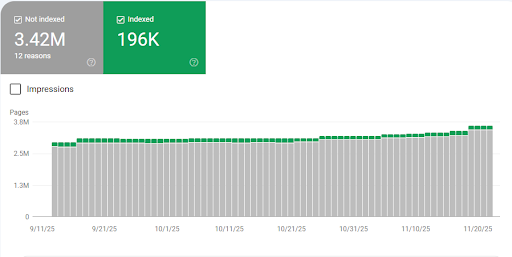
- Google Search Console (GSC): for indexing, coverage patterns, and bulk trend analysis
- GA4: for engagement rate, conversions, and content clusters
- Screaming Frog / Sitebulb: for large crawls, template-level diagnostics
- Ahrefs / SEMrush: for keyword clusters, SERP landscape, internal link suggestions
- Log-file analysis tools: for crawl budget optimization
- Automation scripts (Python / Node): for metadata, internal linking, content generation
- BigQuery: for processing millions of URL or keyword rows
Example enterprise workflow
In our audits, we often export 500,000+ URLs into BigQuery, cluster them using automation, and rebuild taxonomies based on real user pathways.
Framework for Scaling SEO Content, Metadata & Internal Linking
1. Content Scaling Framework
Step 1: Build Core Topic Clusters
Use the Hub & Spoke model:
- Hub page = Parent category
- Spokes = Subcategories or supporting articles
Step 2: Define Templates Per Content Type
- Product pages
- Category pages
- Location pages
- Guides
- Use-case pages
Step 3: Automate Content Modules
Repetitive blocks should be generated programmatically:
- FAQs
- Specifications
- Comparison tables
2. Metadata Scaling Framework
Diagram (conceptual):
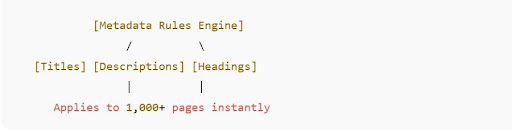
Rules should be used:
- Keywords
- Attributes
- Product names
- Brand logic
- Category variable
3. Internal Linking Scaling Framework
Core Rule Types:
- Contextual links: Based on keywords in body text
- Hierarchical links: Category/tree structure
- Cross-cluster links: Hub & Spoke
Before/After Example:
| Before (Non-scalable) | After (Scalable) |
| Manual insertion | Automated rules |
| Orphan pages | Zero orphan pages |
| Weak PageRank flow | Strong distribution |
Technical Considerations for Scalable SEO
1. Indexation Governance
Large sites must implement:
- Robots.txt rules
- Noindex for thin or filtered URLs
- Log-based monitoring
- Crawl budget optimization
2. Scalable Sitemap Strategy
For 1,000+ pages, use:
- Segmented sitemaps
- Auto-updating XML feeds
- Priority adjustments for high-value pages
3. Canonical Logic
Rules should prevent:
- Duplicate sorting URLs
- Duplicate parameters
- Duplicate category variants
4. Dynamic Page Generation
Common in e-commerce and real estate:
- Faceted navigation
- Query parameters
- Infinite combinations
We often test which combinations deserve indexation by reviewing:
- Search demand
- Conversion data
- Internal site search patterns
5. Schema at Scale
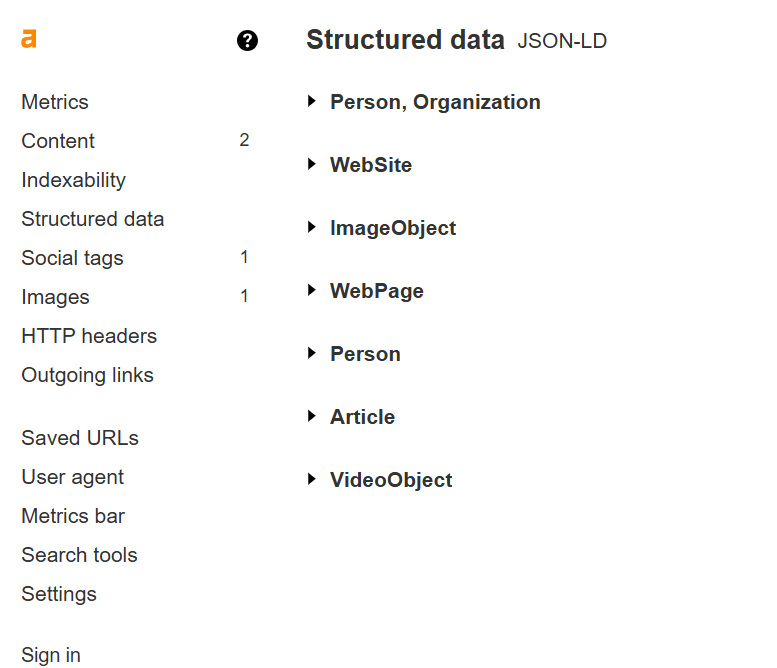
Apply:
- Product
- Article
- FAQ
- Breadcrumb
- HowTo
- Organization
Managed via templates, not manual entry.
Challenges & Common Mistakes in Scalable SEO
1. Over-indexation
Indexing every filtered page leads to:
- Thin content
- Crawl waste
- Duplicate issues
2. Template Bloat
When templates accumulate unnecessary modules → page speed decreases.
3. Lack of Governance
In one enterprise content team (30+ writers), we saw metadata overwritten by hand, breaking automation rules.
4. Fragmented Taxonomy
A common issue in large e-commerce websites:
- Duplicate subcategories
- Overlapping collections
- Ambiguous naming
5. Inadequate Internal Linking
Pages become isolated, weakening overall authority.
6. Poor Change Management
Website migrations break scalable systems entirely. This is your OUT link anchor: website migrations.
What This Means for Businesses
Companies managing 1,000+ URLs must stop thinking of SEO as individual page optimization. Instead, scalable SEO shifts decision-making to:
1. System Design → Not Page Design
Leaders must invest in:
- Taxonomy
- Templates
- Automation
2. Data-Centric Operations
Decisions based on:
- Logs
- Search trends
- Internal search
- Engagement rate
- Conversion pathways
3. Cross-Functional Ownership
Scalable SEO requires collaboration between:
- SEO team
- Developers
- Content team
- Product owners
- Data analysts
4. Long-Term ROI
Scalable SEO creates compounding value:
- Faster indexing
- Higher consistency
- Lower operational cost
- Stronger rankings
The Business Case for Scalable SEO in Enterprise Environments
Scalable SEO is no longer optional for enterprise websites with 1,000+ pages. It is a foundational approach that combines architecture, automation, taxonomy, and technical governance to ensure that every new page contributes to not harming your organic visibility.
By implementing a scalable SEO architecture, supported by the right tools, metadata automation, structured content workflows, and internal linking rules, businesses can unlock significant growth, reduce operational strain, and maintain a competitive edge in increasingly complex SERPs.
When executed correctly, scalable SEO turns your website into a self-optimizing system that grows with you, not against you.
Actionable Checklist (Implementation Guide)
Architecture & Taxonomy
- Audit current SEO information architecture (IA)
- Build scalable taxonomy with clear hierarchy
- Define templates for each content type
Template & Automation
- Implement metadata rules engine
- Automate FAQs, tables, components
- Standardize breadcrumbs & schema
Crawl & Indexation
- Segment sitemaps
- Clean parameter URLs
- Configure canonical rules
- Review logs monthly
Internal Linking
- Build a hierarchical linking system
- Add contextual auto-linking
- Fix orphan pages
Content Scaling
- Use hubs & spokes
- Standardize content blocks
- Maintain template governance
Governance & QA
- Automate QA rules
- Create migration SOPs
- Align SEO, dev & product teams
When SEO shifts from manual tasks to scalable systems, businesses unlock a level of consistency and growth that simply isn’t possible with traditional methods. A well-structured architecture reduces risks, accelerates indexing, and ensures every new page contributes not competes within your ecosystem. This is how enterprise websites stay resilient in fast-changing, AI-driven search environments.
If you want to implement a scalable SEO framework that’s engineered for long-term impact, Chapters Digital Solutions is ready to support your growth.