


In 2026, Google’s crawling and indexing systems have become more selective, AI-driven, and intent-focused than ever before. While many technical SEO fundamentals remain essential, the role of the sitemap has evolved. Today, sitemap SEO is no longer just about listing URLs; it’s about helping search engines interpret content priority, freshness, structure, and relationships in an increasingly complex digital ecosystem.
At Chapters Digital Solutions, our technical audits across ecommerce, SaaS, and real estate websites consistently show that optimized sitemaps directly improve crawl efficiency, accelerate indexation, and enhance visibility across AI-powered SERP features.
This guide breaks down what sitemaps mean in 2026, how to structure them properly, what Google now expects, and the best practices you should follow to support crawl health, indexing, and long-term SEO performance.
What Is a Sitemap in 2026?
A sitemap is a structured XML file that helps search engines understand which pages exist on your website, how they are organized, and how frequently they change. While XML remains the standard, the purpose of the sitemap has expanded due to advancements in:
- AI-driven crawling
- Prioritized content evaluation
- Dynamic discovery systems
- Entity and relationship mapping
- Structured data interpretation
In 2026, a sitemap does three core things:
- Guides Google’s AI crawlers toward your most important content.
- Signals freshness and priority through the <lastmod> tag.
- Reinforces structured content relationships, especially when supported by schema markup.
Google still states that sitemaps do not guarantee indexing, but when configured correctly, they significantly increase your chances of being crawled consistently and prioritized for indexation.
Why Sitemap SEO Still Matters in 2026
As SEO expert Marie Haynes explains, “A sitemap is not a ranking factor; it’s an indexing factor. It ensures that Google knows what you want indexed.”
This distinction is even more important in 2026, as Google’s crawling systems have become more selective and rely heavily on clear structural signals.
As websites grow more dynamic, especially ecommerce platforms, SaaS documentation hubs, real estate listing sites, and news publishers, crawl inefficiency becomes a significant issue. A well-crafted sitemap helps solve this by:
- Reducing crawl waste
- Highlighting canonical, index-worthy URLs
- Supporting discovery of new or recently updated content
- Improving orphan page detection
- Reinforcing structured content relationships
Even with Google’s increased reliance on AI-driven crawling, sitemap SEO remains foundational. It helps search engines understand page hierarchy, content importance, freshness, and intent, ultimately improving your chances of consistent crawling and timely indexation.
How Sitemaps Support Indexing
One of the biggest issues we see in technical audits is indexing issues caused by weak internal linking, duplicate content, and poor site architecture.
A well-optimized sitemap helps mitigate these issues by:
- Ensuring Google sees only authoritative, index-worthy URLs
- Excluding thin, duplicate, or parameterized URLs
- Prioritizing high-value pages with correct <lastmod> signals
- Helping Google recrawl updated content faster
In 2026, Google’s indexation systems are more selective, meaning not all URLs qualify for index inclusion. Your sitemap acts as a reinforcement layer, signaling which URLs deserve attention and which should be ignored.
In multiple client audits across ecommerce and real estate websites, we observed that 27–43% of URLs inside submitted sitemaps were either non-indexable or blocked by canonicals. After restructuring the sitemap, removing thin URLs, and updating <lastmod> signals, Google recrawled the affected pages within 48–72 hours, and indexation improved by an average of 18%.
Sitemap SEO Best Practices for 2026
1. Use the XML Format (Still the Standard)
Google still relies on XML files as the preferred format for sitemaps.
A basic sitemap structure looks like this:
<?xml version=”1.0″ encoding=”UTF-8″?>
<urlset xmlns=”http://www.sitemaps.org/schemas/sitemap/0.9″>
<url>
<loc>https://www.example.com/</loc>
<lastmod>2026-01-15</lastmod>
<priority>1.0</priority>
</url>
</urlset>
Best Practice Refinements:
- Always include <lastmod> (using the full W3C Datetime format for maximum precision).
- Avoid <changefreq> as Google determines this from crawl data.
- Use <priority> strategically for large sites, but rely more on strong internal linking.
2. Submit a Sitemap Index File
A sitemap index (sitemap_index.xml) is essential for larger websites, as it points to multiple smaller sitemaps.
<sitemapindex xmlns=”http://www.sitemaps.org/schemas/sitemap/0.9″>
<sitemap>
<loc>https://www.example.com/sitemap-pages.xml</loc>
</sitemap>
<sitemap>
<loc>https://www.example.com/sitemap-products.xml</loc>
</sitemap>
</sitemapindex>
Benefits: Supports modular organization, improves crawl prioritization, and allows category-specific updates.
3. Split Sitemaps by Content Type
In 2026, Google prefers structured, topic-based sitemaps. Highly recommended splits:
- Pages
- Blog posts
- Products
- Categories
- Locations
- Media (optional)
This helps reinforce entity relationships and improves your ability to diagnose indexation issues quickly.
4. Explicitly Declare the Sitemap in robots.txt
While Search Console is the primary submission channel, confirm your sitemap index location in your robots.txt file for all crawlers.
Example:
- User-agent: *
- Disallow: /admin/
- Sitemap: https://www.example.com/sitemap_index.xml
5. Exclude URLs That Should NOT Be Indexed
Do NOT include any URLs that are: filtered, paginated, internal search results, parameterized, duplicate content, staging, or have a noindex tag. If a URL shouldn’t rank, it shouldn’t exist in your sitemap.
6. Use Correct Canonical Alignment
Ensure every sitemap URL matches its canonical tag. Misaligned canonicals remain a top cause of indexing confusion, soft 404s, and crawl inefficiency.
7. Update Sitemaps Automatically (Dynamic Generation)
Modern CMSs and headless frameworks must generate sitemaps dynamically. This ensures Google always sees the freshest version of your site, and the <lastmod> date is accurate.
8. Use Sitemaps to Reinforce Structured Data (Schema)
Your sitemap works best when paired with schema markup.
Example: If your sitemap lists 150 product URLs, each product page should include Product schema, Review schema, and Offer schema.
This improves entity mapping, search understanding, eligibility for SERP enhancements, and AI overview visibility.
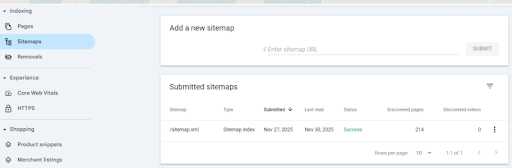
9. Monitor Sitemap Health in Google Search Console
Check Search Console weekly for:
- 404s, Redirects, and Blocked-by-robots URLs
- Mismatched canonicals
- “Indexed, not submitted” discrepancies (which may indicate weak internal linking)
Common Sitemap Mistakes to Avoid in 2026
- Submitting URLs returning 404 or 302 status codes.
- Submitting URLs blocked in robots.txt.
- Including pages marked with noindex.
- Missing the essential <lastmod> attributes.
- Using outdated or static sitemap files.
Sitemap SEO Checklist for 2026
- XML format only
- Use the Sitemap Index for modular organization
- Keep URLs clean & canonical
- Include <lastmod> (with full W3C Datetime) for all URLs
- Exclude non-index URLs
- Leverage dynamic generation
- Connect sitemap + schema
- Declare the index file in robots.txt
- Monitor weekly in Search Console
The future of sitemap SEO lies in precision and prioritization. Brands that implement these modern best practices will benefit from faster indexing, stronger visibility, and better eligibility for advanced SERP features in 2026 and beyond.