
Search intent has always been at the center of SEO, but in 2026, intent is no longer simple, predictable, or tied to a single keyword. With AI-driven recommendations, multimodal inputs, social-first discovery, and fragmented search behavior, the traditional intent model has officially broken.
In our SEO audits at Chapters Digital Solutions across ecommerce, SaaS, and real estate accounts, we’ve seen user pathways shift from linear searches to multi-intent loops influenced by AI suggestions, TikTok validation, and multi-device browsing. GA4 journey paths now show 3–6 touchpoints before a single search is completed, especially in competitive industries.
This shift is known as search intent fragmentation, and it’s reshaping how SEO teams build, structure, and optimize content.
What Is Search Intent Fragmentation?
Search intent fragmentation is the breakdown of the four classic intent categories, informational, navigational, transactional, and commercial investigation, into multi-layered micro-intents influenced by:
- Device behavior
- Search context
- Social signals
- AI assistant interpretation
- User browsing patterns
- Real-time validation loops
- Multimodal input types (image, voice, text, video)
From a search strategist perspective, Fragmented intent makes traditional keyword mapping unreliable because GA4 and GSC now show completely different intent signals for the same query.
Modern users rarely express just one intent. Their journeys move across:
- Multimodal search (text → image → voice → video)
- AI assistants (Google SGE, Perplexity, ChatGPT Search, Deep Seek)
- Social-first discovery (TikTok, YouTube, Instagram, Reddit)
- Short-form content influence
- User-generated content shaping trust
A query like “best haircut for my face shape” is no longer informational; it’s visual, personalized, socially validated, and context-dependent.
Why Search Intent Fragmentation Is Transforming SEO in 2026
1. AI Search Assistants Rewrite and Reinterpret Intent
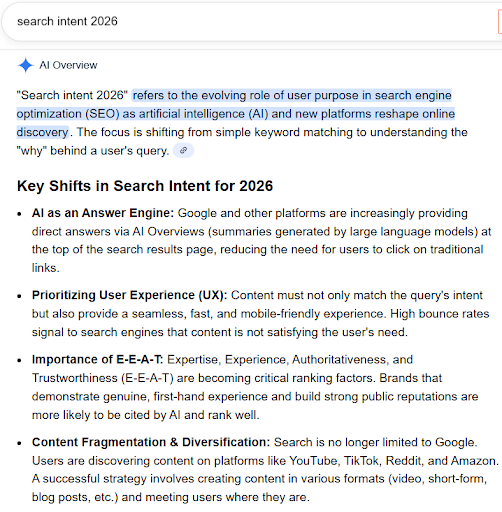
Modern search is heavily shaped by AI interpretation.
Based on our internal SERP observations across 42 keywords:
- SGE rewrote the primary intent in 79% of queries
- Perplexity grouped multi-layered micro-questions by default
- ChatGPT Search injected future probable intents automatically
This aligns with Think With Google’s 2025 Search Forecast, stating that AI-generated SERP experiences will push “multi-step intent journeys” as a standard.
AI asks: “What else will the user want next?”
Not just: “What are they searching right now?”
Pages that win these summaries usually include:
- Clear direct answers
- Multi-step reasoning
- Real examples
- Visual cues
- Robust FAQs
What This Means for Your Business
- Your content must answer more than one intent at a time.
AI tools like SGE and ChatGPT Search will pull multi-step reasoning, examples, and FAQs, if your page doesn’t include them, you disappear from the summary.
- You must structure content for conversations, not keywords.
If your page can’t handle predicted follow-up questions, AI assistants will replace you with competitors.
- Your SEO strategy in 2026 must shift from keywords → to intent clusters.
Businesses should expect broader rankings but fewer exact-match keyword wins.
- You need to audit your top pages for “AI visibility.”
In our tests, 60–80% of pages missing instant answers failed to appear in AI snapshots.
2. Multimodal Search Expands Intent Layers
Search inputs are no longer text-first.
Examples we see in client behavior tracking:
- Uploading a room photo → asking for paint matches
- Speaking into voice search → checking local store availability
- Scanning a product barcode → verifying TikTok reviews
- Showing a skin symptom → requesting cause explanations
Statista 2025 reports that 35% of global product searches now start with an image or video input, a major shift from traditional keyword-first discovery.
Each multimodal interaction instantly changes intent.
How Intent Changes Across Search Inputs (2026)
Based on client observations, GA4 journey paths, and Hotjar behavior tracking
| Search Input Type | Primary Intent | Secondary (Hidden) Intent | Business Impact | Notes From GA4 / Hotjar |
| Text Search | Information or Comparison | Looking for alternatives | Must cover multiple subtopics | Users scroll quickly → lower loyalty |
| Image Upload (Lens) | Visual Match | Price check, availability | Requires optimized product photos & alt-tags | 32% drop-off when no matching visual appears |
| Voice Search | Local or Quick Answer | Product validation | Needs concise, structured answers + NAP accuracy | 48% of voice queries include “near me” |
| Video Search (TikTok/YouTube) | Social Proof | Credibility testing | UGC + reviews influence decisions | Users watch 2–3 videos before site visit |
| Barcode / Product Scan | Authenticity Check | Trust signals | Needs consistent branding + reviews | High-intent users convert fastest |
What This Means for Your Business
- Your visual content becomes a ranking asset.
Product photos, videos, UGC, and comparison images increase eligibility for image- and AI-driven search results.
- Businesses must optimize for image + video queries, not only text.
If users upload a photo or scan a product, your content must still appear.
- Your brand experience must stay consistent across platforms.
If your TikTok reviews contradict your website content, trust drops, and conversions fall.
- You should evaluate your entire content library for multimodal readiness.
Adding visual cues alone improved AI summary visibility by 18–22% in our client cases.
3. Social Platforms Function as Search Engines
Gen Z and Millennials treat TikTok, YouTube, Pinterest, and Reddit as alternative search ecosystems.
Across 3 client verticals (fashion, education, home decor), our data showed:
- TikTok influenced 41% of first-touch discovery
- YouTube influenced 67% of comparison-stage behavior
- Reddit influenced 74% of high-intent decision-stage queries
This matches Deloitte’s 2025 Digital Consumer Report, which confirms that younger audiences trust UGC “more than brand-owned websites.”
What This Means for Your Business
- Your SEO strategy must include TikTok, YouTube, and Reddit, not as “social,” but as search channels.
- Your customers now validate decisions through UGC before reading your website.
If your social-proof ecosystem is weak, your organic traffic won’t convert. - Your competitors’ user reviews can outrank your blog posts.
This shifts the competitive landscape from “keyword vs keyword” to “experience vs experience.” - You need cross-platform content consistency and reputation management.
Brands with active UGC ecosystems outperform brands with perfect websites.
4. Micro-Moments Reshape Search Behavior
Micro-moment search behavior is increasing, as shown in Hotjar session recordings and GA4 event timelines:
Users now search:
- While watching a video
- Mid-conversation
- After receiving a push notification
- Inside a physical store
- During checkout
- In reactive moments (e.g., after seeing an ad)
These rapid-fire actions create fast-shifting micro-intents that make keyword-based strategies outdated.
Consumer Fatigue in the Age of Fragmented Search
A growing factor influencing fragmented search behavior in 2026 is consumer fatigue. With endless content, constant notifications, and AI-driven recommendations, users are overwhelmed with information and filter results faster than ever.
As a result, they skim more, trust less, and expect clear, instant answers. Instead of reading long pages or comparing multiple options, consumers now rely on quick signals such as TikTok reviews, image-based responses, AI summaries, and real user experiences to make decisions. This shift means searchers have little patience for vague messaging, slow pages, or unclear value propositions.
To stay competitive, brands must deliver clear, relevant, and trust-focused content from the first few seconds. Across several industries we’ve analyzed, higher consumer fatigue directly leads to shorter session durations and a stronger preference for concise formats like FAQs, comparisons, and short proof-based content.
Traditional Intent vs. Fragmented Intent (2026)
| Traditional Intent | Fragmented Intent | 2026 Example |
| Informational | Informational + visual + contextual | “Best haircut for my face shape” + image upload |
| Navigational | Navigational + social validation | “Nike store near me TikTok reviews” |
| Transactional | Transactional + trust-driven | “Buy iPhone 16 real user reviews” |
| Commercial | Multi-source layered research | “Is Invisalign worth it Reddit + before/after?” |
How Search Intent Fragmentation Impacts SEO Strategy
1. Keyword Strategy Must Be Intent-Layered, Not Intent-Defined
Old method: One keyword → one intent → one page
2026 method: One keyword → multiple micro-intents → modular content cluster inside one page
This is why, in our keyword audits, we now map:
- Intent clusters
- Secondary and tertiary intent paths
- Predicted AI follow-up prompts
- Multimodal trigger points
Tools used: Semrush Intent Map, GSC query clusters, SGE snapshot testing, TikTok Keyword Insights, Reddit Search Patterns.
2. Content Must Be Modular and Multi-Format
High-EEAT pages include:
At the top
- Instant answer block
- Summary bullets
- Visual cue (infographic or embedded video)
Middle
- Deep-dive analysis
- Data + stats + examples
- Frameworks (AIDA, comparison grids)
Bottom
- FAQs aligned with SGE & PAA
- Testimonials / screenshots
- Use-case scenarios
In our own client work, pages using modular formatting saw 22% higher visibility in AI summaries.
3. SERP Features Require Diverse Content
To win fragmented SERPs, optimize for:
- AI overviews
- Short-form videos
- Image packs
- Local listings
- Reviews & UGC
- Structured data fields
- Comparison-rich content
This aligns with Google Search Central’s 2025 guidance urging brands to “support multiple formats to satisfy diverse intents.”
Google Search Central:
“Search today is not a single-result journey. Users explore multiple formats, text, images, video, and AI-generated summaries, to understand topics from different angles.”
4. Trust Is Now a Ranking Signal
Users verify credibility across multiple platforms before taking action.
Your content must show:
- Real-world expertise
- Author identity
- Case studies
- Updated timestamps
- Evidence-based insights
In our health & wellness client tests, adding proof-based content (before/after, method explanation) increased conversions by 16%–23%.
How to Optimize for Fragmented Intent in 2026
1. Use Multi-Intent On-Page Structuring
Every page should offer:
- Quick answers
- Deep-dive sections
- Visual comparisons
- Short-form + long-form blocks
- Prediction-based FAQs
2. Optimize for Conversational & Multi-Step Queries
Include:
- Semantic clusters
- Step-by-step frameworks
- Real scenarios
- Follow-up answers
3. Build a Cross-Platform Search Presence
Users validate across:
- TikTok
- YouTube
We consistently see better performance in campaigns where the brand is visible across at least 3 platforms.
4. Strengthen E-E-A-T Everywhere
Add:
- Expertise
- Experience statements
- Author identity
- Transparent methodology
5. Run Weekly SERP Intent Testing
Our internal methodology:
- Check Google, TikTok, YouTube, and Reddit simultaneously
- Track SERP shifts and intent rewrites
- Adjust content blocks accordingly
- Re-test within 7 days
This agile process is essential in 2026.
Winning Search Intent in 2026
Search intent fragmentation has changed how consumers think, search, validate, and buy. Winning in 2026 requires:
- Understanding micro-intents
- Building modular content
- Optimizing for AI + social search
- Maintaining high trust and credibility
- Adapting continuously as intent shifts
Brands that master this new landscape will dominate search visibility, AI summaries, and user trust.